
Your muscles started quietly disappearing in your 30s. By now, if you've been mostly sedentary, you may have lost 15-25% of your muscle mass. Your bones have been thinning since menopause began. And that stubborn belly fat that appeared seemingly overnight? It's directly connected to the metabolic slowdown that happens when muscle tissue shrinks.
This isn't scare tactics. This is physiology. And the good news is that every single one of these processes responds to one intervention: picking up heavy things and putting them down again.
Most "strength training for women over 50" articles miss the menopause connection. They treat this as a generic aging problem. It's not. Estrogen loss accelerates muscle breakdown, blunts your body's response to protein, extends recovery time, and shifts fat storage to your abdomen. The training approach that worked at 35 won't work at 55 — not because you're weaker, but because your physiology has changed.
What you'll find here: the menopause-specific science, a phased beginner protocol with exact sets and reps, the protein math most articles skip, and an honest section on what doesn't work (including the "toning" myth that's wasted millions of women's time).
New to Menopause? If strength training is just one piece of the puzzle you're trying to solve — hot flashes, sleep disruption, brain fog, weight gain — start with the complete picture. Our free Menopause Starter Guide covers evidence-based strategies across all major symptoms, including a strength training quick-start checklist. Download the free guide →
The Menopause-Muscle-Bone Connection: Why This Is Different After 50
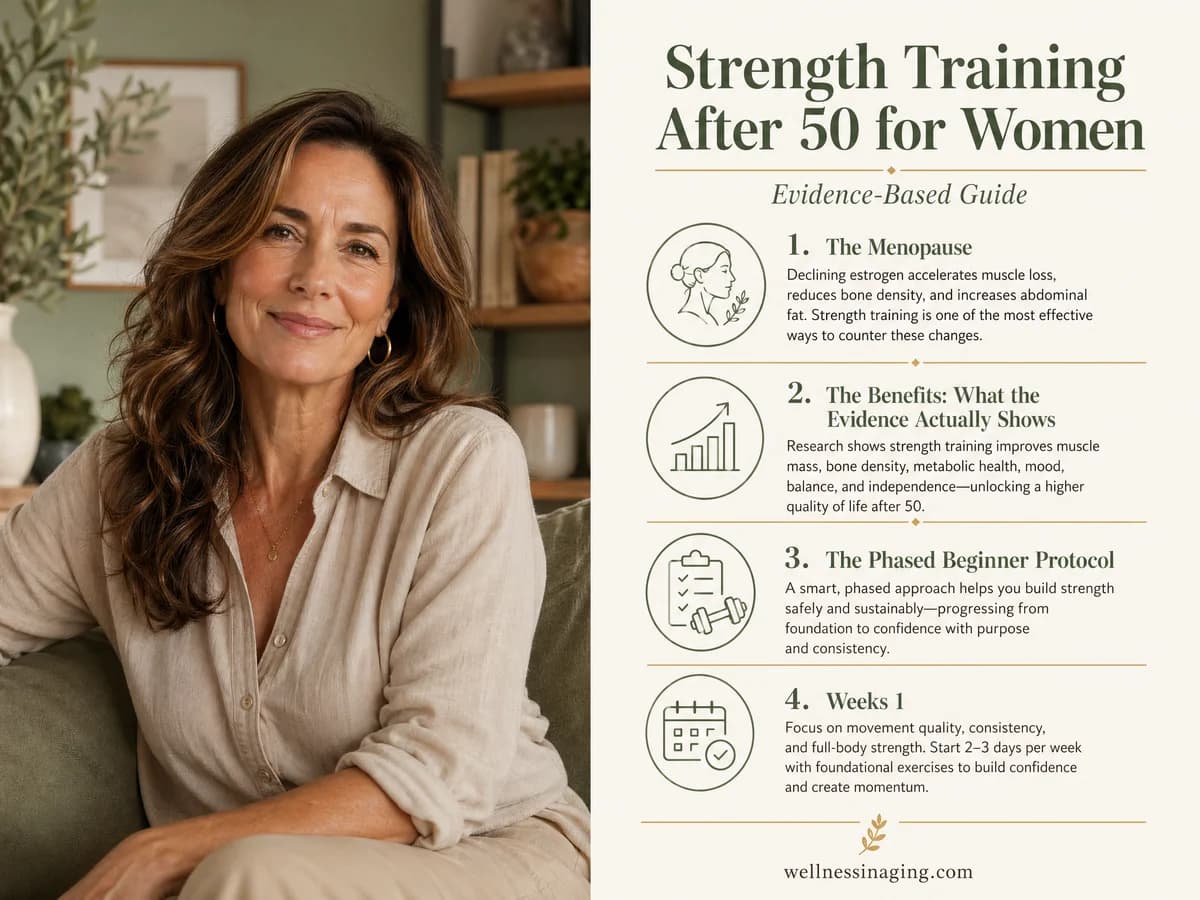
Most fitness advice ignores what happens inside your body when estrogen declines. Here's what the research shows.
Sarcopenia (muscle loss) accelerates dramatically after 50. Women lose approximately 3-8% of muscle mass per decade after age 30, but this rate jumps to 5-10% per decade after 50 (Volpi et al., 2004). By age 70, inactive women may have lost 30-40% of their total muscle mass.
This isn't just about appearance. Each pound of muscle burns 6 calories per day at rest versus 2 calories for fat. Less muscle means a slower metabolism, which is why weight management becomes harder.
Bone density loss follows a predictable but alarming pattern. Women lose 1-2% of bone density per year for 5-7 years immediately following menopause, then 0.5-1% annually thereafter. That can add up to 20% of total bone density lost in the first years after menopause (NIH Osteoporosis and Related Bone Diseases National Resource Center).
One in two women over 50 will break a bone due to osteoporosis. Those aren't great odds.
The estrogen connection is what makes this different from generic aging advice:
- Estrogen enhances muscle protein synthesis. Without it, your muscles respond less effectively to both protein intake and exercise — a phenomenon called "anabolic resistance."
- Estrogen suppresses osteoclasts (cells that break down bone). After menopause, bone breakdown accelerates while bone building slows.
- Estrogen has anti-inflammatory effects. Without it, chronic low-grade inflammation accelerates muscle breakdown.
- Estrogen aids muscle repair. Post-menopausal women need longer recovery periods between training sessions.
This is why strength training becomes more important after menopause, not less. You're working against a physiological tide — but the tide is absolutely reversible with the right approach.
The Benefits: What the Evidence Actually Shows
Not all benefits have equal evidence. Here's what research supports, with honest ratings.
Muscle Mass Preservation and Growth — Evidence: Strong
A meta-analysis of 49 randomized controlled trials shows progressive resistance training increases lean body mass by 1.1-1.4 kg (2.4-3 lbs) in older women over 12-24 weeks (Peterson et al., 2011). This reverses age-related muscle loss and maintains independence for daily activities like carrying groceries, climbing stairs, and getting up from the floor.
The mechanism is straightforward: mechanical tension from lifting triggers muscle protein synthesis and activates satellite cells (muscle stem cells) needed for repair and growth.
Bone Density Improvement — Evidence: Strong
Progressive, high-intensity resistance training at greater than 70% of your one-rep max increases bone mineral density by 1-3% at the spine and hip in postmenopausal women (Watson et al., 2018). This is significant because without intervention, you'd be losing 1-2% per year.
Intensity matters. Low-intensity resistance training (less than 50% of max) shows minimal bone benefit. You need to lift weights that are genuinely challenging — not the 3-pound dumbbells gathering dust in most home gyms.
Loading must also be site-specific. Squats and deadlifts load the hip and spine. Overhead presses load the spine.
Bicep curls? They do almost nothing for bone density.
Mood and Depression — Evidence: Strong
Resistance training reduces depression symptoms with an effect size of 0.57 (moderate to large) in meta-analyses — comparable to aerobic exercise and, for some women, comparable to medication (Gordon et al., 2018). It increases BDNF (brain-derived neurotrophic factor), endorphins, self-efficacy, and body image.
For menopausal women specifically, this may counter estrogen-related mood changes through neuroplasticity and stress resilience. If you've noticed increased anxiety or depression during perimenopause or menopause, strength training is one of the most evidence-backed interventions.
Metabolic Rate and Fat Loss — Evidence: Strong
Consistent strength training can increase resting metabolic rate by 7-8%, approximately 80-100 extra calories burned per day without doing anything different (Hunter et al., 2004). This directly counters the 100-200 calorie per day decline in metabolic rate that occurs between ages 50-70.
Strength training is also particularly effective at reducing visceral (abdominal) fat — the dangerous belly fat that increases after menopause due to estrogen decline. While you can't spot-reduce fat (more on this below), strength training plus a slight calorie deficit is the most effective combination for body composition change.
Hot Flash Reduction — Evidence: Moderate
Some studies show 20-30% reduction in hot flash frequency and severity with regular strength training; others show no effect (Daley et al., 2015). The proposed mechanism involves improved thermoregulation and reduced BMI. Women with higher baseline BMI seem to benefit more.
Aerobic exercise shows more consistent hot flash reduction than resistance training alone. If hot flashes are your primary concern, check out our guide on managing hot flashes during menopause.
Balance and Fall Prevention — Evidence: Strong
Progressive resistance training reduces fall risk by 34% in older adults (Sherrington et al., 2019). Strengthening the lower body — glutes, quads, calves — improves proprioception and reaction time. Hip strength directly correlates with your ability to catch yourself during a stumble.
The Phased Beginner Protocol: Weeks 1-4, 5-12, and Beyond
Starting too hard is the most common mistake. Your joints, tendons, and nervous system need time to adapt before your muscles can handle real load. Here's the evidence-based progression.
Phase 1: Neuromuscular Adaptation (Weeks 1-4)
Goal: Learn movement patterns, avoid debilitating soreness, build habit.
| Parameter | Target |
|---|---|
| Frequency | 2 days per week, full body each session |
| Sets | 1-2 per exercise |
| Reps | 12-15 per set |
| Intensity | Light weight (50-60% of max, or RPE 5-6 out of 10) |
| Rest between sets | 60-90 seconds |
Expect significant soreness after your first 2-4 sessions. This diminishes as your body adapts. The weights should feel manageable — you're training your nervous system to recruit muscle fibers efficiently, not pushing for growth yet.
Phase 2: Building Base Strength (Weeks 5-12)
Goal: Progressive overload begins. Weights start to feel challenging.
| Parameter | Target |
|---|---|
| Frequency | 2-3 days per week |
| Sets | 2-3 per exercise |
| Reps | 10-12 per set |
| Intensity | Moderate weight (60-70% of max, or RPE 6-7 out of 10) |
| Rest between sets | 60-90 seconds |
Now you begin adding weight. When you can complete all sets and reps with good form, increase weight by 2.5-5 lbs the next session.
Even small increases add up. Adding 2.5 lbs per week for 8 weeks equals 20 lbs of progress.
Phase 3: Muscle and Bone Stimulus (Month 4+)
Goal: Maximize muscle growth and bone density gains.
| Parameter | Target |
|---|---|
| Frequency | 2-4 days per week |
| Sets | 3-4 per exercise |
| Reps | 8-12 per set |
| Intensity | Challenging weight (70-80% of max, or RPE 7-8 out of 10) |
| Rest between sets | 90-120 seconds for compound movements |
This is where bone density improvements happen. Research shows you need to work at greater than 70% of your one-rep max to stimulate bone adaptation.
The last 2-3 reps of each set should feel genuinely difficult.
Progressive overload methods (use one per session, alternate over weeks):
- Increase weight by 2.5-5 lbs when you complete all sets/reps with good form
- Add 1-2 reps per set before increasing weight
- Add an extra set (2 sets becomes 3 sets)
- Slow down the lowering phase to 3-4 seconds
Deload weeks: Every 4-6 weeks, reduce volume by 30-40% (lighter weights or fewer sets) to allow full recovery. This isn't laziness — it's how you prevent overtraining and continue making progress.
Quick Resource: Building a complete menopause wellness plan that includes strength training, sleep strategies, nutrition adjustments, and symptom relief? Our Menopause Starter Guide provides the evidence-based framework to address everything at once. Get the free guide →
The Six Essential Exercises
These compound movements recruit multiple muscle groups and provide the greatest return on time. Master these before adding isolation exercises.
1. Goblet Squat — Lower body: quads, glutes, core
Hold a dumbbell or kettlebell at your chest and squat down, keeping your weight in your heels and chest up. Targets quadriceps, glutes, and core while loading the hip and spine for bone benefit.
Progress from bodyweight to dumbbell to barbell back squat over months.
2. Romanian Deadlift — Posterior chain: hamstrings, glutes, lower back
Push your hips back while keeping shins vertical, feeling a stretch in your hamstrings. This hip hinge pattern is essential for daily movements like picking things up. Start with dumbbells; progress to barbell.
3. Push-Up or Dumbbell Press — Upper body: chest, shoulders, triceps
Start with wall push-ups if needed, progress to incline (hands on bench), then knee push-ups, then full push-ups. Alternatively, lie on a bench and press dumbbells. Targets pectorals, anterior deltoids, triceps, and core.
4. Dumbbell Row — Upper body: back, biceps
Pull your elbow back and squeeze your shoulder blade toward your spine. This counteracts the forward shoulder posture that comes with aging and desk work. Can be done single-arm with one hand on a bench for support.
5. Overhead Press — Shoulders, triceps, core
Press dumbbells or a barbell overhead while keeping core engaged. Builds shoulder strength and provides bone-loading stimulus for the spine. If you've got shoulder issues, use neutral grip (palms facing each other) or substitute landmine press.
6. Hip Thrust — Glutes, hamstrings
Shoulders on a bench, drive through your heels to lift hips. This provides the strongest glute activation of any exercise and is critical for hip stability, fall prevention, and functional movements like getting up from chairs. Progress from bodyweight glute bridge to weighted hip thrust. For comprehensive pelvic health, combine hip thrusts with targeted pelvic floor exercises.
Joint Modifications
Knee pain or osteoarthritis: Avoid deep squats below 90 degrees. Use box squats (squat to a seated position on a box), leg press machine, or step-ups with a lower step height. Keep weight in heels; don't let knees cave inward.
Shoulder impingement: Avoid wide-grip overhead pressing and upright rows. Use neutral-grip pressing with dumbbells (palms facing each other) or landmine press.
Lower back sensitivity: Use goblet squats instead of barbell back squats. Try trap bar deadlifts or Romanian deadlifts with lighter weight and higher reps. Maintain neutral spine and engage core before each rep.
Protein: The Numbers Most Articles Skip
You can't build muscle without adequate protein. Post-menopausal women need more protein than younger women due to anabolic resistance — your muscles are less responsive to protein intake.
Target intake: 1.2-1.6 g protein per kg bodyweight daily
| Your Weight | Protein/Day (Low End) | Protein/Day (High End) |
|---|---|---|
| 120 lbs (54 kg) | 66g | 88g |
| 140 lbs (64 kg) | 77g | 102g |
| 150 lbs (68 kg) | 82g | 110g |
| 160 lbs (73 kg) | 88g | 117g |
| 180 lbs (82 kg) | 99g | 131g |
Distribution matters. Aim for 25-40g protein per meal across 3-4 meals. Muscle protein synthesis peaks at 25-40g per meal.
Eating 80g at dinner while skipping breakfast? Less effective than spreading intake throughout the day.
Example day for a 150 lb woman (target: 95g):
- Breakfast: 3 eggs + Greek yogurt = 30g
- Lunch: 4 oz chicken breast = 30g
- Post-workout: Protein shake = 20g
- Dinner: 5 oz salmon = 35g
- Total: 115g (slightly above target for insurance)
If you struggle to hit these targets through food alone, whey protein powder (20-25g per scoop) is the most studied and effective supplement. For dairy-free options, pea protein works well. For more on supporting recovery and sleep, see our article on magnesium for menopause.
Recovery: Why You Need More Rest Than You Think
Post-menopausal women need longer recovery than younger women. This isn't a weakness — it's physiology.
Why recovery is slower after menopause:
- Reduced growth hormone secretion (GH supports tissue repair)
- Estrogen's absence means more muscle damage and inflammation
- Muscle protein synthesis is less efficient
- Decades of joint use means more microtrauma to manage
Practical implications:
- Allow 48-72 hours between training the same muscle groups (versus 48 hours for younger women)
- Take a deload week every 4-6 weeks — reduce volume by 30-40%
- On non-lifting days, use active recovery: light walking, gentle yoga, swimming
- Prioritize 7-9 hours of sleep — growth hormone peaks during deep sleep stages
Sleep is non-negotiable. If hot flashes or night sweats are disrupting your sleep, address this first — you can't out-train poor sleep. Consider a cooling mattress pad or magnesium glycinate (200-400mg) before bed.
What Doesn't Work: Honest Limitations
Being honest about what lacks evidence builds trust. Here's what you should stop wasting time on.
1. "Toning Weights" (1-3 lb dumbbells for endless reps) — Not Recommended
The claim: Light weights with 20+ reps create "long, lean muscle" without bulk.
The reality: There's no such thing as "toning" muscle. Muscle fibers either grow (hypertrophy) or shrink (atrophy).
Light weights don't provide enough stimulus for muscle growth or bone density improvement. The "long and lean" look comes from muscle growth plus fat loss — achieved through challenging weights and nutrition, not pink dumbbells.
What works instead: Moderate to heavy loads (70-85% of max), 8-12 reps, progressive overload.
2. Spot Reduction (Ab exercises to lose belly fat) — Not Recommended
The claim: Hundreds of crunches will flatten your stomach.
The reality: You can't choose where you lose fat. Fat loss is systemic, determined by genetics and hormones.
Post-menopausal belly fat is particularly stubborn due to estrogen decline — only overall calorie deficit plus strength training to maintain muscle will reduce it.
What works instead: Full-body strength routine + slight calorie deficit + patience.
3. Passive Treatments (EMS, vibration plates, sauna suits) — Not Recommended
The claim: These devices build muscle or burn fat without traditional exercise.
The reality:
- EMS: May prevent atrophy in bedridden patients; doesn't build meaningful muscle in healthy adults
- Vibration plates: Weak evidence for minor balance improvements; doesn't replace strength training
- Sauna suits: Temporary water loss only; no fat loss
What works instead: Actual resistance training with progressive overload.
4. Cardio-Only for Weight Loss — Insufficient
The claim: Walking or cycling will prevent muscle loss and maintain metabolism.
The reality: Cardio is excellent for cardiovascular health but doesn't prevent sarcopenia or bone loss. It may even accelerate muscle loss if you're in a calorie deficit without strength training.
What works instead: Strength training 2-3x/week PLUS cardio 2-3x/week.
Never cardio-only after 50.
5. Training Every Day Without Rest — Not Recommended
The claim: More is better — daily workouts accelerate results.
The reality: Muscle adaptation occurs during recovery, not during the workout. Overtraining causes fatigue, decreased performance, increased injury risk, and hormonal disruption. Older adults need more rest, not less.
What works instead: 2-4 strength sessions per week with 48-72 hours between training the same muscle groups.
Who This Is For — and Who Should See a Doctor First
Good candidates for starting strength training:
- Women 45+ who want to prevent or reverse muscle and bone loss
- Women experiencing menopausal symptoms (especially mood changes, sleep issues, metabolic slowdown)
- Women with controlled chronic conditions (diabetes, hypertension, mild arthritis) who have medical clearance
- Complete beginners — it is never too late to start
See your doctor first if:
- Uncontrolled hypertension (blood pressure greater than 160/100)
- History of heart disease or stroke
- Severe osteoporosis (T-score less than -2.5 or prior fragility fractures)
- Uncontrolled diabetes
- Recent surgery or injury
- Joint pain that worsens with activity
If you've got osteoporosis, you can still strength train — but avoid spinal flexion exercises (sit-ups, toe touches) and work with a qualified professional initially.
The Bottom Line
Start with two full-body sessions per week using the Phase 1 protocol: 1-2 sets of 12-15 reps at a weight that feels manageable but not trivial. Focus on the six essential movements. Eat 25-40g of protein at each meal. Sleep 7-9 hours.
Give yourself 48-72 hours between sessions.
After 4 weeks, begin increasing weight when you can complete all reps with good form. By month 4, you should be working at an intensity where the last 2-3 reps feel genuinely challenging — this is where bone density improvements happen.
The process is slower than the internet promises. Visible muscle changes take 8-12 weeks. Bone density changes take 6-12 months.
But the mood, energy, and strength improvements often appear within the first month — and those alone are worth the effort.
Ready to Start? Strength training is most effective when it's part of a comprehensive menopause wellness strategy. Get the complete roadmap — symptom relief, nutrition, sleep, exercise, and evidence-based supplement guidance — in our free Menopause Starter Guide. Download your free guide →
For the flexibility and joint mobility side of this equation, read our guide on yoga for menopause. For more on the exercise-mood connection, see walking routines for stress relief.
References
Peterson et al., Medicine & Science in Sports & Exercise, 2011 | Watson et al., Journal of Bone and Mineral Research, 2018 | Gordon et al., JAMA Psychiatry, 2018 | Volpi et al., Current Opinion in Clinical Nutrition & Metabolic Care, 2004 | Hunter et al., Sports Medicine, 2004 | Sherrington et al., Cochrane Database of Systematic Reviews, 2019 | Bauer et al., Journal of the American Medical Directors Association, 2013 | Daley et al., Cochrane Database of Systematic Reviews, 2015
References
-
Volpi, E., Nazemi, R., & Fujita, S. (2004). Muscle tissue changes with aging. Current Opinion in Clinical Nutrition & Metabolic Care, 7(4), 405-410.
-
Peterson, M. D., Sen, A., & Gordon, P. M. (2011). Influence of resistance exercise on lean body mass in aging adults: a meta-analysis. Medicine & Science in Sports & Exercise, 43(2), 249-258.
-
Watson, S. L., Weeks, B. K., Weis, L. J., et al. (2018). High-intensity resistance and impact training improves bone mineral density and physical function in postmenopausal women with osteopenia and osteoporosis. Journal of Bone and Mineral Research, 33(2), 211-220.
-
Gordon, B. R., McDowell, C. P., Hallgren, M., et al. (2018). Association of efficacy of resistance exercise training with depressive symptoms: meta-analysis and meta-regression analysis of randomized clinical trials. JAMA Psychiatry, 75(6), 566-576.
-
Hunter, G. R., McCarthy, J. P., & Bamman, M. M. (2004). Effects of resistance training on older adults. Sports Medicine, 34(5), 329-348.
-
Sherrington, C., Fairhall, N. J., Wallbank, G. K., et al. (2019). Exercise for preventing falls in older people living in the community. Cochrane Database of Systematic Reviews, 1, CD012424.
-
Bauer, J., Biolo, G., Cederholm, T., et al. (2013). Evidence-based recommendations for optimal dietary protein intake in older people: a position paper from the PROT-AGE Study Group. Journal of the American Medical Directors Association, 14(8), 542-559.
-
Daley, A., Stokes-Lampard, H., Thomas, A., & MacArthur, C. (2015). Exercise for vasomotor menopausal symptoms. Cochrane Database of Systematic Reviews, 1, CD006108.
-
Lowe, D. A., Baltgalvis, K. A., & Greising, S. M. (2010). Mechanisms behind estrogen's beneficial effect on muscle strength in females. Exercise and Sport Sciences Reviews, 38(2), 61-67.
-
Fragala, M. S., Cadore, E. L., Dorgo, S., et al. (2019). Resistance training for older adults: Position statement from the National Strength and Conditioning Association. Journal of Strength and Conditioning Research, 33(8), 2019-2052.
This content is for informational purposes only and does not constitute medical advice. Always consult with a qualified healthcare provider before starting any new supplement or treatment. Individual results may vary.
Free Download
The Menopause Starter Guide
Evidence-rated strategies, a supplement reference, and a symptom tracker. 12 pages, free.
Frequently Asked Questions
Related Articles

Yoga for Menopause: Which Styles Help Your Symptoms
Yoga for menopause: which styles reduce hot flashes, improve sleep, and ease anxiety. Evidence ratings, style-symptom matching, and what doesn't work.
Read article →
Probiotics and Menopause: The Gut-Hormone Connection (What the Science Says)
Your gut bacteria directly regulate estrogen metabolism through the estrobolome. Here's what probiotics can and can't do for menopause — with strain-specific evidence for bone health, mood, and vaginal health.
Read article →
Omega-3 for Menopause: What It Helps With (and What It Doesn't)
Omega-3s have strong evidence for mood, joint pain, and heart health during menopause — but NOT for hot flashes. Here's the RCT data, the correct EPA vs DHA dose by symptom, and how to avoid rancid fish oil.
Read article →