
There is no single best menopause supplement. Anyone who tells you otherwise is either selling one or hasn't read the clinical trials.
What does exist: a shortlist of compounds with decent evidence for specific symptoms. Matching the right supplement to your actual symptom is what most roundup articles skip entirely. This guide ranks them by evidence strength, not search volume.
Quick Match: Symptom → Supplement
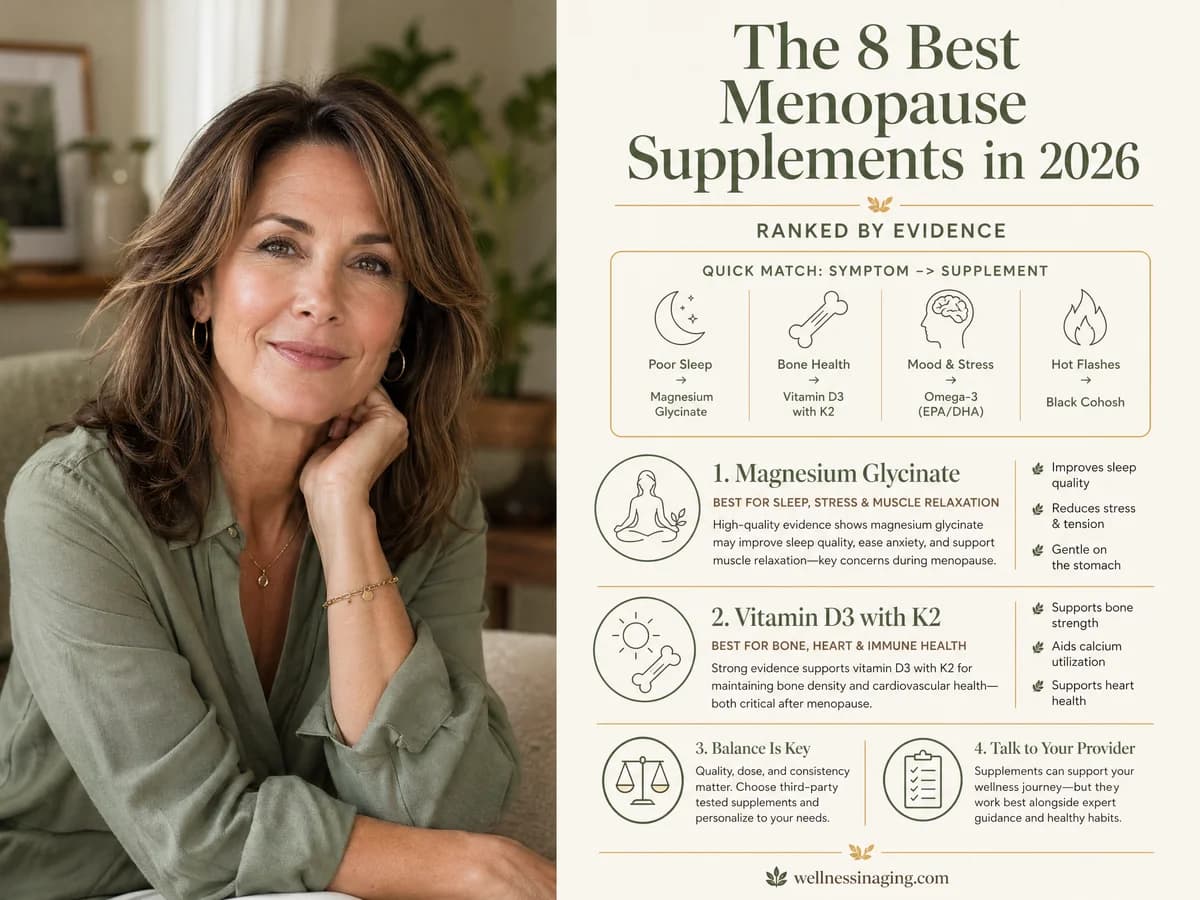
| Symptom | Best Evidence-Backed Option |
|---|---|
| Sleep disruption | Magnesium glycinate |
| Hot flashes + night sweats | Black cohosh, soy isoflavones |
| Mood changes, anxiety | Omega-3 (EPA), magnesium glycinate, B vitamins |
| Bone health | Vitamin D3 + K2 + magnesium |
| Brain fog, cognition | Omega-3 (DHA), B vitamins, magnesium L-threonate |
| Low energy, fatigue | B vitamins, omega-3 |
| Gut changes, bloating | Probiotics |
| All-purpose foundation | Magnesium + vitamin D3 + K2 |
1. Magnesium Glycinate — Sleep, Anxiety, Bone Health
Evidence rating: Strong (sleep, anxiety, bone) | Weak (hot flashes)
Magnesium is the closest thing to a universal menopause supplement. Not because it fixes everything, but because estrogen helps your kidneys retain magnesium — and as estrogen drops, urinary magnesium loss rises. Postmenopausal women become functionally deficient in magnesium even without changing their diet (Muñoz et al., Journal of Women's Health, 2017).
The evidence for sleep is the strongest of any supplement on this list. A 2012 randomized controlled trial by Abbasi et al. found that 500mg of magnesium daily for 8 weeks reduced time to fall asleep by nearly 18 minutes and improved overall sleep quality scores. Boyle et al. (2017) reviewed 18 studies and found consistent, modest reductions in anxiety with 200–400mg daily.
For bone health, higher magnesium intake is associated with 2–3% greater bone mineral density in postmenopausal women (Tucker et al., American Journal of Clinical Nutrition, 1999). Magnesium is also required to activate vitamin D — meaning your vitamin D supplement works significantly better when you're not magnesium-deficient.
What it won't do: Directly reduce hot flash frequency. Some women notice fewer night sweats once their sleep improves, but that's an indirect effect. Don't buy magnesium for hot flashes specifically.
Dose: 200–400mg elemental magnesium as glycinate (or bisglycinate — same thing), taken 30–60 minutes before bed. Start at 100–150mg for the first week and increase gradually to reduce the chance of loose stools.
Important: Look for "magnesium glycinate" or "bisglycinate" on the label. Magnesium oxide — the most common form in cheap supplements — absorbs at roughly 4%. Glycinate absorbs at 46–50%. It's the same price difference as a coffee.
Who should avoid: Anyone with significant kidney disease (eGFR under 30). Kidneys clear magnesium, and impaired clearance can cause dangerous buildup.
For a deep-dive on forms, dosages, and drug interactions, see our full guide on magnesium for menopause.
2. Vitamin D3 with K2 — Bone Health, Mood
Evidence rating: Strong (bone, fall prevention) | Moderate (mood)
Up to 42% of US adults are vitamin D deficient, and postmenopausal women are disproportionately affected — reduced sun exposure, age-related decline in skin synthesis, and the estrogen–vitamin D relationship all compound the problem.
The bone health evidence is extensive. A 2009 meta-analysis by Bischoff-Ferrari et al. found that 700–1,000 IU of vitamin D3 daily reduced fall risk by 19% in older adults. Falls lead to fractures, and fractures are a leading cause of disability and death in postmenopausal women. This isn't theoretical — it's one of the most replicated findings in geriatric medicine.
For mood, the evidence is meaningful but not definitive. A 2013 meta-analysis by Anglin et al. found that low vitamin D levels were significantly associated with depression risk, and supplementation produced modest improvements. The mechanism is plausible: vitamin D receptors exist throughout the brain and influence serotonin synthesis.
Dose: 1,000–2,000 IU of vitamin D3 daily for maintenance. If you're deficient (under 20 ng/mL on a blood test), a provider may recommend 2,000–4,000 IU for 12 weeks. Always pair with vitamin K2 (100–200 mcg as MK-7), which directs calcium to your bones rather than your arteries. Get your levels tested annually.
What it won't do: Fix hot flashes, improve sleep directly, or substitute for estrogen in bone protection.
Who should avoid: People with hypercalcemia or certain granulomatous diseases (sarcoidosis). Discuss with your provider if you're on thiazide diuretics.
3. Black Cohosh — Hot Flashes and Night Sweats
Evidence rating: Moderate
Black cohosh is the most-studied non-hormonal supplement specifically for vasomotor symptoms — hot flashes and night sweats. The evidence is real but measured.
Osmers et al. (2005) ran a 12-week randomized controlled trial in 304 women. Standardized black cohosh extract (Remifemin, 40mg twice daily) reduced hot flash frequency by 26% compared to placebo. A 2010 meta-analysis by Shams et al. covering 9 RCTs found modest but statistically significant benefit for vasomotor symptoms overall. The effect size is consistently smaller than HRT — typically 20–30% reduction versus 75–90% with estrogen — but for women who can't or won't use hormones, that's a meaningful difference.
The mechanism isn't what was originally assumed. Black cohosh doesn't act as a phytoestrogen. Current evidence points to serotonergic pathways and possible modulation of dopamine receptors in the hypothalamic thermoregulatory center. This is why it doesn't carry estrogen-like cancer risks (though the data on this is still being studied).
Dose: 40mg of standardized isopropanolic extract twice daily (80mg total). Look for extract standardized to 2.5% triterpene glycosides. This is the exact formulation used in the clinical trials.
Timeline: 4–8 weeks. This is not a fast-acting supplement. Women who quit at two weeks rarely see the full effect.
Who should avoid: Anyone with liver disease. There are rare reports of hepatotoxicity. Stop immediately if you notice dark urine, yellowing of the skin, or abdominal pain, and see your provider.
Who should not expect much: Women with severe VMS. Black cohosh works best for mild-to-moderate hot flashes. If you're changing your shirt four times a day, you need a stronger intervention — and that conversation starts with your doctor.
4. Omega-3 Fatty Acids (EPA/DHA) — Mood, Cognition, Joints
Evidence rating: Moderate (mood, cognition) | Strong (cardiovascular)
Omega-3s are one of those supplements where the evidence is genuinely useful for menopause even though the studies weren't always conducted in menopausal women specifically.
For mood: A comprehensive 2006 review by Freeman et al. in the Journal of Clinical Psychiatry found that EPA at doses above 1,000mg daily has antidepressant effects comparable to low-dose SSRIs in mild-to-moderate depression. The mechanism involves reducing inflammatory cytokines (IL-6, TNF-alpha), which rise during menopause and directly affect mood regulation.
For cognition: A 2010 RCT by Yurko-Mauro et al. (n=485) found that DHA at 900mg daily improved memory and learning in older adults with mild cognitive decline. For joint pain, omega-3s reduce the same inflammatory pathways that drive menopause-related joint aches.
Dose: For mood and cognition, aim for 1,000–2,000mg of EPA plus 500–1,000mg DHA daily. Buy triglyceride-form fish oil (not ethyl ester), tested for mercury and PCBs (look for IFOS or USP certification).
Timeline: 4–6 weeks for mood benefit; 12+ weeks for cognitive effects.
Who should use caution: Anyone on anticoagulants (warfarin, aspirin therapy). At doses above 3g/day combined EPA+DHA, bleeding risk increases. The doses above are generally safe, but check with your prescriber.
5. B Vitamins (B6, B12, Folate) — Energy, Mood, Cognition
Evidence rating: Moderate
B vitamins rarely get star billing in menopause discussions, but they're working in the background on several pathways that matter: neurotransmitter synthesis (serotonin, GABA, dopamine all require B6), homocysteine clearance (elevated homocysteine accelerates cognitive decline and cardiovascular risk), and mitochondrial energy production.
Stomach acid production declines with age, and several medications common in menopause (PPIs, metformin) actively deplete B12. A meaningful proportion of women over 50 are subclinically B12 deficient without knowing it — the symptoms look exactly like menopause: fatigue, mood changes, cognitive fog.
Smith et al. (2010) found in a well-designed RCT that B6, B12, and folate supplementation together reduced brain atrophy rates by 30% in individuals with high homocysteine and mild cognitive impairment.
Dose: Look for a B-complex with methylated forms — methylcobalamin (B12), methylfolate (folate), and pyridoxal-5-phosphate (B6). These are the active forms that bypass conversion problems some people have. B6 should not exceed 100mg/day long-term — nerve toxicity can occur at higher doses.
Timeline: Energy and mood changes within 2–4 weeks.
6. Soy Isoflavones — Hot Flashes (Depending on Gut Bacteria)
Evidence rating: Mixed
Soy isoflavones work as phytoestrogens — they bind weakly to estrogen receptors (roughly 1/1,000th the potency of estradiol) and can modestly reduce hot flash frequency. The Cochrane review by Lethaby et al. (2007), covering 25 trials, found that high-dose soy (≥54mg isoflavones daily) reduced hot flash frequency by about 20% versus placebo.
The catch is equol-producer status. Equol is a metabolite of daidzein (a soy isoflavone) that has stronger estrogenic activity — but only 30–50% of Western women have the gut bacteria that produce it. Whether soy works for you may depend on something you can't easily test.
Dose: 50–90mg isoflavones daily from standardized extract or soy protein isolate.
Who to consider: Women with mild-to-moderate hot flashes, willing to try for 8–12 weeks to see if they're an equol-producer. If there's no improvement after 10 weeks, this form of intervention probably isn't doing much for you.
Who should discuss with their doctor first: Women with a personal or family history of estrogen-sensitive breast cancer. Current evidence doesn't clearly show increased risk, but it's a conversation worth having.
7. Probiotics — Gut Health, Mood, Equol Production
Evidence rating: Moderate (emerging)
The connection between the gut microbiome and menopause symptoms is an active area of research that most roundup articles still ignore. Estrogen influences gut barrier integrity, and the gut microbiome shifts as estrogen declines. This contributes to digestive changes, mood dysregulation via the gut-brain axis, and — critically — whether or not you're an equol-producer from soy.
Reis et al. (2018) conducted a meta-analysis showing certain Lactobacillus and Bifidobacterium strains consistently reduced anxiety symptoms. The mechanism runs through the vagus nerve and neurotransmitter production in the gut.
Dose: 10–50 billion CFU daily. Look for multi-strain formulas containing Lactobacillus rhamnosus, L. plantarum, Bifidobacterium longum, and B. breve.
Timeline: GI symptoms improve in 2–4 weeks. Mood and systemic effects take 4–8 weeks.
8. Calcium — Bone Health (Food First)
Evidence rating: Strong (bone density) | Mixed (cardiovascular concerns)
Calcium is essential for bone health, and postmenopausal women need 1,200mg daily total. The problem is that most evidence now favors getting this from food first. A 2010 meta-analysis by Bolland et al. found that calcium supplements alone (without vitamin D) may increase cardiovascular event risk by 20–30%. The risk doesn't appear with dietary calcium.
If you supplement: Use calcium citrate (better absorbed than carbonate, especially if you take a PPI or have low stomach acid), no more than 500–600mg at a time, always with vitamin D3 and K2, and ideally in addition to dietary calcium rather than instead of it.
What Doesn't Work — The Honest Section
This section exists because trust requires honesty. These are supplements that are heavily marketed for menopause but have weak or no evidence behind them.
Red clover: The 2007 Cochrane review found no significant benefit over placebo across most trials. It's in many "menopause blend" products. It's not earning its place there.
Wild yam cream: Marketed as "natural progesterone." The body cannot convert diosgenin (wild yam's active compound) into progesterone. Zero clinical evidence for menopause symptoms. Pure marketing.
Dong quai: A 1997 RCT by Hirata et al. showed no benefit over placebo for hot flashes. May increase photosensitivity and bleeding risk.
DHEA (without medical supervision): Over-the-counter hormone precursor that converts to testosterone and estrogen in the body. Evidence for menopause symptom relief is weak. Safety concerns include androgenic side effects and possible stimulation of hormone-sensitive cancers. Not a DIY supplement.
Evening primrose oil for hot flashes: A 1994 RCT showed no significant benefit over placebo for hot flash frequency or severity. Reasonable for breast tenderness; not for vasomotor symptoms.
High-dose vitamin E for hot flashes: The best-powered study showed a reduction of about one hot flash per day versus placebo. At doses above 400 IU, vitamin E may increase risk of hemorrhagic stroke in some populations. The math doesn't work out.
How to Build a Stack (Without Overdoing It)
Most women don't need all eight of the supplements above. Here's a practical starting framework based on symptoms:
Foundation for most menopausal women:
- Magnesium glycinate 200–400mg at night
- Vitamin D3 2,000 IU + K2 100mcg daily
Add if hot flashes or night sweats are your main concern:
- Black cohosh 40mg BID (standardized extract) — give it 8 weeks
Add if mood, cognition, or fatigue are prominent:
- Omega-3 2,000mg EPA+DHA daily
- B-complex (methylated forms) daily
Add if gut changes have accompanied your transition:
- Probiotic (multi-strain, 10–50 billion CFU)
Start one supplement at a time so you can tell what's working. Give each one at least 4–6 weeks before judging it. And tell your prescriber what you're taking — especially if you're on any chronic medications.
Free Resource: Download the Menopause Starter Guide → — a plain-language summary of symptoms, the supplements with the strongest evidence, and questions to bring to your next doctor's appointment.
Who This Is For — and Who Should See a Doctor First
Supplements can be a useful part of managing menopause symptoms, but they're not right for everyone — and they're never a substitute for medical evaluation when something more serious is going on. Here's how to know where you fit.
Good candidates for menopause supplements:
- Women in perimenopause or early menopause experiencing mild-to-moderate symptoms (occasional hot flashes, disrupted sleep, mood fluctuations)
- Women who prefer to try lifestyle and supplement approaches before considering HRT
- Women who've tried HRT and experienced side effects that made it untenable
- Women using HRT who want additional support for symptoms it doesn't fully address (sleep, energy, cognition)
- Women with confirmed nutrient deficiencies (low vitamin D, magnesium, B12) where supplementation corrects a measurable gap
Consider talking to your doctor first if:
- Your symptoms started before age 40 (premature menopause has different implications and may require different treatment)
- You have a personal or family history of hormone-sensitive cancers (breast, ovarian, uterine) — some supplements have weak estrogenic effects
- You're currently taking blood thinners, immunosuppressants, or thyroid medication (supplement interactions are real and under-discussed)
- Your symptoms are severe enough to interfere with work, relationships, or daily function — supplements rarely move the needle enough for severe VMS
- You have undiagnosed vaginal bleeding or pelvic symptoms that haven't been evaluated
- You've had liver disease, gallbladder issues, or kidney impairment (certain supplements are contraindicated)
Supplements are not a replacement for medical care when:
- Cognitive changes are worsening rapidly or affecting your ability to function — this needs neurological evaluation, not B vitamins
- You're experiencing cardiovascular symptoms (chest tightness, palpitations, shortness of breath) — these need workup regardless of menopausal timing
- You have symptoms of severe depression, suicidal thoughts, or inability to care for yourself — this is a medical emergency, not a supplement situation
- Bone density testing shows osteoporosis — prescription treatment may be necessary alongside any supplement protocol
This article is for informational purposes only. Supplement safety and effectiveness vary by individual — always discuss new supplements with your healthcare provider, especially if you take prescription medications.
References
- Abbasi B et al. (2012). "The effect of magnesium supplementation on primary insomnia in elderly." Journal of Research in Medical Sciences, 17(12): 1161–1169.
- Boyle NB et al. (2017). "The effects of magnesium supplementation on subjective anxiety and stress." Nutrients, 9(5): 429.
- Tucker KL et al. (1999). "Potassium, magnesium, and fruit and vegetable intakes are associated with greater bone mineral density." American Journal of Clinical Nutrition, 69(4): 727–36.
- Muñoz N et al. (2017). "Elevated serum magnesium in relation to estrogen and menopause." Journal of Women's Health, 26(2).
- Bischoff-Ferrari HA et al. (2009). "Fall prevention with supplemental and active forms of vitamin D." BMJ, 339: b3692.
- Anglin RE et al. (2013). "Vitamin D deficiency and depression in adults: systematic review and meta-analysis." British Journal of Psychiatry, 202(2): 100–107.
- Osmers R et al. (2005). "Efficacy and safety of isopropanolic black cohosh extract for climacteric symptoms." Obstetrics & Gynecology, 105(5): 1074–1083.
- Shams T et al. (2010). "Efficacy of black cohosh-containing preparations on menopausal symptoms: a meta-analysis." Alternative Therapies in Health and Medicine, 16(1): 36–44.
- Freeman MP et al. (2006). "Omega-3 fatty acids: evidence basis for treatment and future research in psychiatry." Journal of Clinical Psychiatry, 67(12): 1954–1967.
- Lethaby A et al. (2007). "Phytoestrogens for vasomotor menopausal symptoms." Cochrane Database of Systematic Reviews, (4): CD001395.
- Reis DJ et al. (2018). "The anxiolytic effect of probiotics: a systematic review and meta-analysis." PLoS One, 13(6): e0199041.
- Bolland MJ et al. (2010). "Effect of calcium supplements on risk of myocardial infarction and cardiovascular events." BMJ, 341: c3691.
- Hirata JD et al. (1997). "Does dong quai have estrogenic effects in postmenopausal women?" Fertility and Sterility, 68(6): 981–986.
Free Download
The Menopause Starter Guide
Evidence-rated strategies, a supplement reference, and a symptom tracker. 12 pages, free.
Related Articles
Probiotics and Menopause: The Gut-Hormone Connection (What the Science Says)
Your gut bacteria directly regulate estrogen metabolism through the estrobolome. Here's what probiotics can and can't do for menopause — with strain-specific evidence for bone health, mood, and vaginal health.
Read article →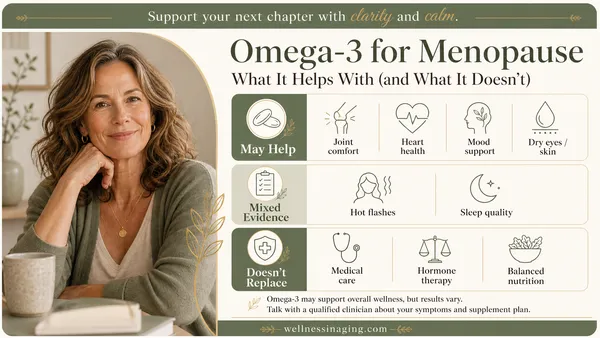
Omega-3 for Menopause: What It Helps With (and What It Doesn't)
Omega-3s have strong evidence for mood, joint pain, and heart health during menopause — but NOT for hot flashes. Here's the RCT data, the correct EPA vs DHA dose by symptom, and how to avoid rancid fish oil.
Read article →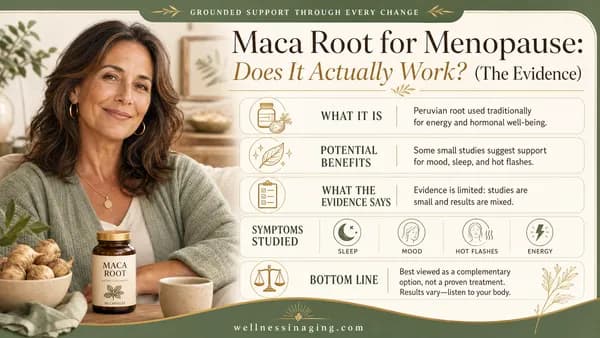
Maca Root for Menopause: Does It Actually Work? (The Evidence)
Maca root is widely promoted for menopause. Here's what the RCTs actually show — what it helps with (libido, mood), what it doesn't (hot flashes), and the correct dose.
Read article →