
Free Resource: Menopause Starter Guide Get our 12-page guide with symptom tracking templates, evidence-ranked remedies, and questions to ask your doctor. Download free
Your nervous system used to handle stress like a thermostat — register a threat, respond proportionally, return to baseline. Now it's more like a smoke alarm that goes off when you're making toast. A mildly frustrating email triggers heart pounding. A warm room becomes a full-body meltdown. Sleep — when you finally get it — doesn't restore you the way it used to.
This isn't weakness or poor coping. This is what happens when declining estrogen rewires your stress response system.
Most articles skip the mechanism. Here it is: estrogen modulates your HPA (hypothalamic-pituitary-adrenal) axis, the command center for stress hormones. As estrogen declines, this axis becomes hyperreactive — producing exaggerated cortisol responses to ordinary stressors. Postmenopausal women show 10-20% higher baseline cortisol levels than premenopausal women, with a flattened daily rhythm that keeps you wired at night when you should be winding down. At the same time, estrogen withdrawal increases amygdala reactivity by approximately 30%, meaning your brain's threat-detection center now flags more situations as dangerous (Borrow et al., 2014; Goldstein et al., 2005).
Add declining serotonin activity (25-30% reduction), loss of progesterone's natural GABA-boosting effects, and increased norepinephrine activity in your arousal centers — and you have a nervous system primed for anxiety, poor sleep, and more frequent hot flashes. This isn't metaphorical. It's measurable neurobiology.
Meditation techniques can directly address these mechanisms. Not through vague "relaxation" but through specific practices that shift autonomic balance, reduce cortisol reactivity, and widen the thermoneutral zone that triggers hot flashes. The key is matching the right technique to your specific symptoms.
Why Menopause Makes Stress Harder to Manage
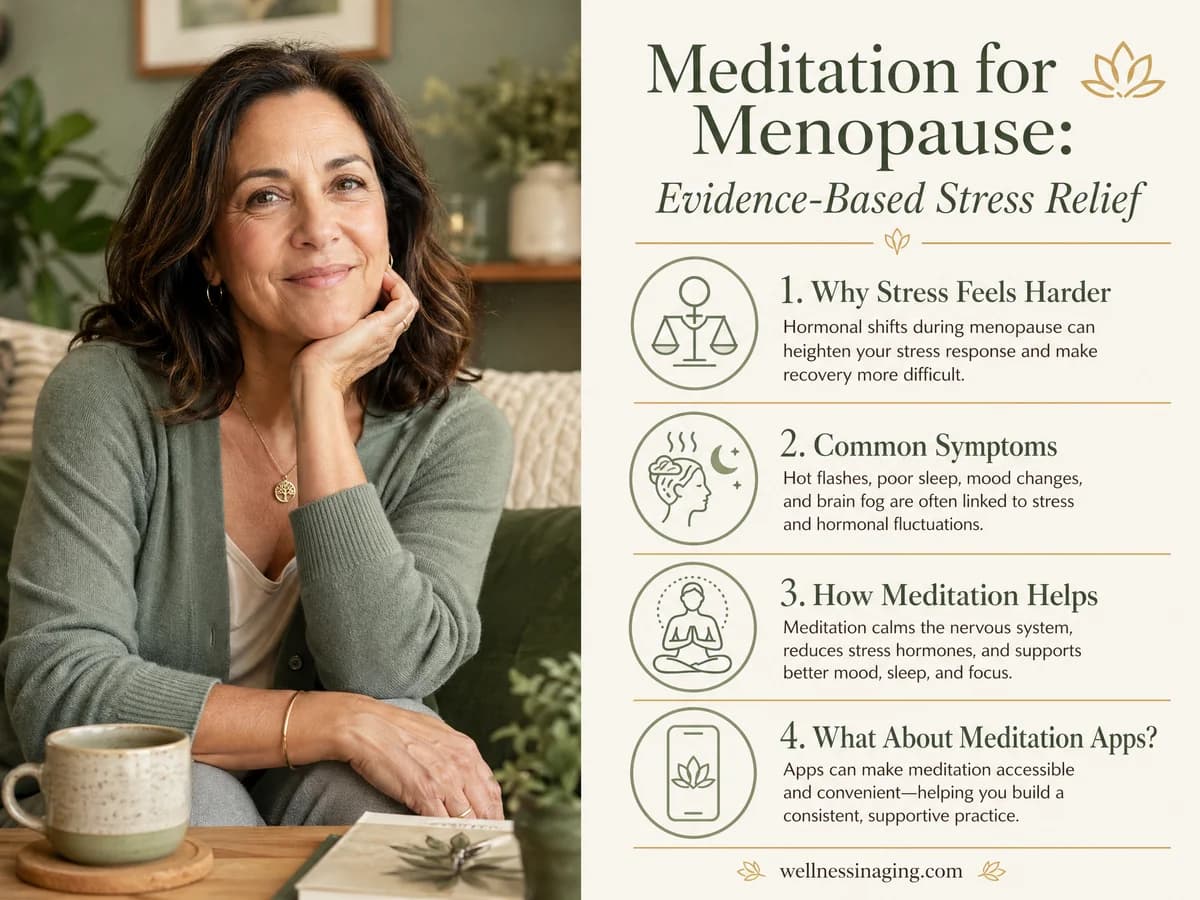
Understanding the biology helps you choose interventions that actually target the problem.
Your HPA axis loses its brakes. Estrogen normally provides negative feedback that tells your stress response to calm down after a threat passes. Without adequate estrogen, cortisol stays elevated longer. A 2009 Seattle Midlife Women's Health Study found 35-40% of perimenopausal women have a "flat" cortisol curve — high at night, low in the morning — compared to just 10% of premenopausal women (Woods et al., 2009). Wired but tired.
Your thermostat narrows. The hypothalamus regulates body temperature within a "thermoneutral zone" — the range where you feel neither hot nor cold. High cortisol narrows this zone by approximately 20%. A body temperature fluctuation that would have been imperceptible before now triggers a hot flash (Thurston et al., 2008). Women with high perceived stress report 1.5-2 times more hot flashes than women with low stress.
Sleep disruption feeds the cycle. Elevated evening cortisol delays sleep onset by 30-60 minutes and reduces slow-wave (deep) sleep by 15-25%. Poor sleep then increases next-day cortisol reactivity by 30-50%, creating a feedback loop where stress causes bad sleep causes more stress (Lampio et al., 2014; Leproult et al., 1997).
Your emotional brain becomes more reactive. fMRI studies show perimenopausal women have exaggerated amygdala responses to negative emotional stimuli. Situations that would have been merely annoying now feel threatening. This isn't catastrophizing — it's your brain's actual response threshold being lowered by hormonal changes.
Interventions that reduce cortisol, increase vagal tone, and calm the amygdala can directly address these mechanisms. That's exactly what specific meditation techniques do.
Symptom-Matched Meditation Guide
Different meditation techniques have different evidence bases for different symptoms. Using MBSR for hot flashes is like using ibuprofen for a bacterial infection — might take the edge off, but you're missing the targeted intervention.
For Hot Flashes: Paced Breathing Protocol
Evidence Rating: Strong (d=0.92)
Paced respiration at 6-8 breaths per minute is the only meditation technique with strong evidence for actually reducing hot flash frequency — not just how much they bother you, but how often they occur.
The landmark study: Freedman and Woodward (1992) found paced breathing reduced hot flash frequency by 44% (p<0.001). A 2013 study of 107 women confirmed these findings, showing 29% reduction in hot flash scores, 26% reduction in anxiety, and 32% reduction in perceived stress — effects that persisted at 6-month follow-up (Sood et al., 2013).
The mechanism: Slow breathing at 6-8 breaths per minute increases vagal tone and shifts your autonomic nervous system toward parasympathetic dominance. This widens your thermoneutral zone by 0.2-0.3 degrees Celsius, making hot flashes less likely to trigger. Fastest-acting meditation technique, too — you can use it as "rescue" intervention when you feel a hot flash coming on.
Quick Win: Paced breathing is the only meditation technique that reduces hot flash frequency, not just how much they bother you. If you try only one technique from this article, make it this one.
The protocol:
- Inhale for 5 seconds, exhale for 5 seconds (6 breaths per minute)
- Practice 15 minutes, twice daily (morning and evening)
- Use as "rescue" at hot flash onset — can abort an oncoming flash in 2-3 minutes
- Benefits appear within 1-2 weeks (faster than other meditation types)
- Continue indefinitely; benefits fade if you stop
What to expect: You may feel improvement quickly with this one. Many women notice reduced hot flash intensity within the first week. By week 6-8, you should see peak benefit if you're practicing consistently.
For Anxiety and Racing Thoughts: MBSR
Evidence Rating: Moderate-Strong (d=0.63)
Mindfulness-Based Stress Reduction is the most-studied meditation approach for menopause. A 2011 RCT of 110 perimenopausal women found 8-week MBSR produced 28% reduction in perceived stress (p<0.001), 25% reduction in anxiety symptoms (d=0.63), 31% improvement in sleep quality, and 15% reduction in hot flash severity — the "bother" factor, not frequency (Carmody et al., 2011).
A 2018 meta-analysis of 486 women across 6 RCTs confirmed moderate effect sizes across vasomotor symptom severity (SMD=-0.35), psychological symptoms (SMD=-0.42), and quality of life (SMD=0.38) (Wong et al., 2018).
The mechanism: MBSR doesn't eliminate anxiety — it changes your relationship to anxiety. fMRI data shows MBSR reduces amygdala reactivity (18% decrease) and increases prefrontal-amygdala connectivity, meaning your rational brain gains more influence over your emotional brain (Innes et al., 2018). Women who complete MBSR don't stop having anxious thoughts. They stop spiraling when they have them.
The protocol:
- 20-30 minutes daily, 6 days per week
- Seated meditation, body scan, or gentle yoga
- Formal 8-week programs available in-person or online
- Palouse Mindfulness offers free MBSR online
- Benefits appear after 4 weeks, peak at 8 weeks, persist 6+ months with continued practice
Minimum effective dose: Even 10 minutes daily shows small benefits (d=0.20-0.30), though the full protocol produces stronger results.
For Sleep Problems: Yoga Nidra or Body Scan
Evidence Rating: Moderate
If your primary issue is falling asleep or staying asleep, yoga nidra and body scan meditation show the most relevant evidence.
A 2020 study comparing body scan to progressive muscle relaxation in 154 perimenopausal women found body scan improved sleep onset latency by 19 minutes (p=0.007), reduced hot flash distress by 24% (p=0.02), and reduced anxiety by 21% (p=0.01). Notably, body scan and PMR were equally effective — both work (Otte et al., 2020).
A separate trial of yoga nidra versus sleep hygiene in 60 perimenopausal women showed yoga nidra improved sleep quality by 38% (PSQI measure), reduced anxiety 29%, and reduced perceived stress 34% (Datta et al., 2017).
The mechanism: Both techniques enhance interoceptive awareness — your ability to sense internal body states without reacting to them. This reduces catastrophic interpretations of hot flashes and night sweats. Yoga nidra induces theta brain waves, the state between wakefulness and sleep.
The protocol:
- 20-30 minutes, once daily before bed
- Lying down position is fine (unlike seated meditation)
- Guided recordings helpful — Insight Timer has free options
- Sleep onset improves within 1 week; sleep quality by week 3-4
Who this is best for: Women who find formal seated meditation difficult, or whose primary complaint is insomnia rather than daytime anxiety. If you fall asleep during the practice, that's not failure — that's the goal.
For General Stress and Mood: PMR + Diaphragmatic Breathing
Evidence Rating: Moderate
Progressive Muscle Relaxation (PMR) combined with diaphragmatic breathing offers a more physical, active alternative to seated meditation.
A 2014 study of 60 perimenopausal women found PMR reduced anxiety by 42% (p<0.001, d=0.81), improved sleep quality by 36%, and reduced perceived stress by 31% (Saensak et al., 2014). These effect sizes are larger than most meditation studies, possibly because PMR is more accessible for women who struggle with "sitting still with thoughts."
The protocol:
- Systematically tense and release 14 muscle groups
- 15-20 minutes daily
- Best done in the evening to lower cortisol before bed
- Combine with diaphragmatic breathing (belly expansion, not chest)
Why this works for meditation skeptics: PMR gives you something to do. You're actively tensing muscles, which paradoxically helps some people relax better than trying to passively observe thoughts.
Take the Next Step Our free Menopause Starter Guide includes a 30-day meditation protocol, symptom tracker, and questions to ask your healthcare provider about stress management. Download your free guide
What About Meditation Apps?
No meditation app has menopause-specific RCT data. None. The evidence we have is for in-person MBSR programs and researcher-administered protocols, not commercial apps.
The adherence problem: A 2019 meta-analysis of 270 studies found the average drop-out rate for meditation apps is 78% by 8 weeks (Flett et al., 2019). Apps work if you use them consistently, but most people don't.
What predicts adherence:
- Shorter sessions (5-10 min) have 1.8x higher completion than 20-30 min
- Push notifications increase usage 1.4x
- Social accountability features increase adherence 1.6x
App recommendations based on available evidence:
| App | Cost | Menopause Content | Evidence Rating |
|---|---|---|---|
| Insight Timer | Free (premium $60/yr optional) | 200+ menopause-tagged meditations | Insufficient (no RCTs, but free) |
| Breathe2Relax | Free | Paced breathing — matches strong evidence | Indirect (paced breathing has RCTs) |
| Calm | $69.99/year | Daily Calm, body scans (no menopause-specific) | Insufficient for menopause |
| Headspace | $69.99/year | "Managing menopause" 10-day course (new, unstudied) | Weak (1 small pilot) |
The practical recommendation: Start with free options. Insight Timer has the largest free library and community features. Breathe2Relax is designed for the paced breathing protocol that has the strongest menopause evidence. Don't pay $70/year for something you'll probably stop using after three weeks.
If you want structured support, an in-person or live-online MBSR course will produce better outcomes than any app — but costs $300-600 and requires 8-week commitment.
HRT + Meditation: Complementary, Not Either/Or
A common question: if I'm on hormone therapy, do I still need stress management?
The answer is yes. HRT and meditation target different mechanisms and produce additive benefits.
The data: A 2012 study found women on HRT who added CBT (which includes meditation-like components) showed an additional 22% reduction in hot flash distress beyond HRT alone (p=0.01) (Ayers et al., 2012). Separately, the Carmody MBSR trial found benefits were independent of HRT use — women on HRT and women not on HRT showed similar reductions in perceived stress (28% vs 26%).
Women on HRT with high stress had 40% more hot flashes than women on HRT with low stress (Thurston et al., 2015). Stress can override HRT's thermoregulatory benefits.
How they work together:
- HRT stabilizes the thermoregulatory set point and restores estrogen-mediated serotonin activity
- Meditation reduces HPA axis reactivity, widens the thermoneutral zone via autonomic shift, improves sleep architecture
- Combined effect: HRT reduces biological vulnerability while meditation reduces environmental and psychological triggers
If you're on HRT and still having breakthrough symptoms, adding stress management may provide the additional relief you're looking for. If you can't or won't use HRT, prioritize stress management as first-line for psychological symptoms.
What Doesn't Work: Save Your Time and Money
Being honest about what lacks evidence is how you build trust in what does work.
Positive Affirmations Alone [Evidence: Weak]
A 2009 study found positive affirmations backfired in people with low self-esteem, increasing negative mood (Wood et al., 2009). No RCTs show benefit for menopause-specific stress. Affirmations without behavioral change or cognitive restructuring are superficial. If you like affirmations, fine — but don't expect them to address hormonal anxiety mechanisms.
CBD for Stress/Anxiety [Evidence: Insufficient]
No menopause-specific RCTs exist. General anxiety data shows mixed results with small effect sizes (d=0.15-0.30). Quality is a major concern: 70% of CBD products are mislabeled (Bonn-Miller et al., 2017). Not recommended until better evidence emerges.
"Adrenal Support" Supplements [Evidence: Weak-Insufficient]
Ashwagandha has moderate evidence for general stress (d=0.52), but not menopause-specific. Rhodiola, holy basil, and licorice root have weak evidence with small studies and publication bias. "Adrenal fatigue" is not a recognized medical diagnosis (Endocrine Society, 2016). These supplements can interfere with cortisol testing and potentially with HRT.
Binaural Beats [Evidence: Weak]
A 2019 meta-analysis found small effects on anxiety (d=0.26) with high risk of bias (Garcia-Argibay et al., 2019). No menopause-specific research exists. The proposed mechanism (brainwave entrainment) is speculative.
Alcohol for Stress Relief [Evidence: Not Recommended]
Alcohol increases cortisol reactivity 12-24 hours later (rebound effect), disrupts sleep architecture (reduces REM, increases night wakings), and is a known hot flash trigger in 30-50% of women. As women on Reddit accurately observe: "Wine helps in the moment, makes everything worse the next day."
Generic Relaxation Tapes [Evidence: Weak-Moderate]
Passive listening without active engagement shows minimal benefit (d=0.10-0.15). The unclear active ingredients — is it the music? the voice? the breathing cues? — make it impossible to know what's helping. Guided practices that require active participation (PMR, body scan) work better than passive background audio.
Common Mistakes Women Make
1. Expecting Meditation to "Cure" Hot Flashes
Meditation reduces hot flash bother/distress by 15-30%, not necessarily frequency. The exception: paced breathing, which reduces frequency by 44%. If you want frequency reduction, paced breathing is the only meditation technique with strong evidence.
2. Giving Up After 1-2 Weeks
Most benefits appear after 4-6 weeks of consistent practice. The "I tried it for a week and it didn't work" conclusion is pervasive but premature. Women who make it to week 4 have 78% likelihood of continuing to 8 weeks and beyond.
3. Only Meditating When Stressed (Reactive Use)
Meditation is preventive, not rescue. Daily practice builds stress resilience over time. Using it only during crises is like exercising only when you're already injured.
4. Choosing the Wrong Type for the Goal
Match your technique to your symptom:
- Hot flashes: Paced breathing (6-8 breaths/min)
- Anxiety/racing thoughts: MBSR, body scan, PMR
- Sleep problems: Yoga nidra, body scan before bed
- Emotional processing: Loving-kindness meditation, journaling
Doing loving-kindness meditation expecting it to reduce hot flashes is using the wrong tool.
5. Over-Reliance on Apps Without Fundamentals
Apps are supplementary. Best outcomes combine initial instruction (in-person MBSR, therapist guidance, or quality online course) + daily practice (app-supported or independent) + community support (group sessions or online forums).
6. Ignoring Sleep Hygiene While Meditating
Meditation helps sleep but can't overcome terrible sleep hygiene. Caffeine after 2pm, screens in bed, and inconsistent sleep schedules will undermine your meditation practice. You need both. For a complete sleep protocol, see our guide on sleep hygiene for menopause.
7. Using Meditation to Avoid Medical Evaluation
If anxiety is new-onset, severe, or impairing function, it warrants medical evaluation. Meditation is not a substitute for treating depression, generalized anxiety disorder, or panic disorder. See our guide on anxiety during menopause for when to seek professional help.
8. Not Combining Meditation with Movement
Meditation and exercise work synergistically for menopause symptoms. Women who combine daily meditation with regular physical activity show 30-40% greater symptom improvement than those doing either alone. Consider pairing your meditation practice with gentle yoga or a simple walking routine for enhanced benefits.
9. Believing "I Can't Quiet My Mind" Means Failure
The goal is not to stop thoughts — it's to notice them without reacting. Mind wandering 100 times and returning attention 100 times is a successful session. This misconception drives 40% of early drop-outs (Dimidjian & Segal, 2015).
For more evidence-based approaches to managing menopause-related stress, see our complete guide on stress management during menopause.
Timeline: What to Expect Week by Week
Week 1-2: May feel worse. Initial discomfort with sitting still, increased awareness of thoughts and body sensations. Some women feel more anxious initially because they're finally noticing how anxious they've been. Paced breathing may show early hot flash benefits.
Week 3-4: Subtle shifts. Slightly less reactive to daily stressors. Better sleep onset. May notice you're catching yourself before spiraling. Still not dramatic.
Week 6-8: Clear benefits. Reduced stress reactivity, fewer bothersome hot flashes, improved mood stability. Most women notice meditation is "working" around this point. Effect sizes peak around week 8.
3+ Months: Sustained changes. Lower baseline anxiety, better stress resilience, lasting sleep improvements. The practice becomes self-reinforcing because you can feel the difference.
The critical window: If you can make it to week 4 with consistent daily practice, you're likely to continue. Most drop-outs happen in weeks 2-3 when initial discomfort hasn't yet given way to benefits.
Who This Is For / Who This Is NOT For
This article is for you if:
- You experience mild-to-moderate stress and anxiety related to perimenopause or menopause
- You have hot flashes that aren't severe enough to warrant HRT, or want additional relief alongside HRT
- Sleep problems stem from racing thoughts or difficulty winding down
- You prefer non-pharmaceutical first-line approaches or want to complement medical treatment
- You're willing to commit to 4-6 weeks of consistent daily practice before expecting results
This is NOT for you if:
- You have anxiety that started suddenly before age 40 (may indicate thyroid or other medical cause — see your doctor)
- You experience panic attacks more than once weekly
- You have depression symptoms alongside anxiety (meditation alone is insufficient — seek professional treatment)
- Symptoms significantly impair work, relationships, or daily function
- You have any thoughts of self-harm (seek immediate medical help)
- You're looking for a replacement for medical care rather than a complement to it
When to see your healthcare provider:
Meditation works best as part of a broader strategy. For most women, that means addressing sleep, exercise, and — if symptoms are severe — discussing HRT or SSRI options with a healthcare provider. Internal links: menopause insomnia remedies, hot flashes and what helps.
The Bottom Line
Start with paced breathing — 5-second inhale, 5-second exhale, 15 minutes twice daily. This single technique has the strongest evidence (44% hot flash reduction) and the fastest timeline (1-2 weeks). Use Breathe2Relax (free app) to guide you.
If anxiety and racing thoughts are your primary complaint, add a daily body scan or PMR practice in the evening. Consider an 8-week MBSR program if you want structured support.
Give any technique at least 4 weeks before deciding it doesn't work. Most drop-outs happen before benefits appear.
Skip the CBD, adrenal support supplements, and positive affirmations. The evidence isn't there. Spend that money on a quality meditation cushion or an MBSR course instead.
If symptoms are severe or worsening despite consistent practice, that's important information — see your healthcare provider to discuss whether HRT, SSRIs, or other medical interventions might be appropriate.
Your Next Step Get our free Menopause Starter Guide with a 30-day meditation protocol, symptom tracker, and evidence-ranked remedy checklist. Download your free guide
For related topics: yoga for menopause symptom relief, brain fog during menopause.
This content is for informational purposes only and does not constitute medical advice. Always consult with a qualified healthcare provider before starting any new supplement or treatment. Individual results may vary.
References
-
Ayers B, Smith M, Hellier J, Mann E, Hunter MS. Effectiveness of group and self-help cognitive behavior therapy in reducing problematic menopausal hot flushes and night sweats (MENOS 2): a randomized controlled trial. Menopause. 2012;19(7):749-759.
-
Borrow AP, Cameron NM. Estrogen and cognition: An ovarian hormone's impact on the brain and implications for menopausal health. Hormones and Behavior. 2014;74:163-185.
-
Carmody JF, Crawford S, Salmoirago-Blotcher E, Leung K, Churchill L, Olendzki N. Mindfulness training for coping with hot flashes: results of a randomized trial. Menopause. 2011;18(6):611-620.
-
Datta K, Tripathi M, Mallick HN. Yoga Nidra: An innovative approach for management of chronic insomnia. Sleep Science and Practice. 2017;1(1):7.
-
Dimidjian S, Segal ZV. Prospects for a clinical science of mindfulness-based intervention. American Psychologist. 2015;70(7):593-620.
-
Freedman RR, Woodward S. Behavioral treatment of menopausal hot flushes: evaluation by ambulatory monitoring. American Journal of Obstetrics and Gynecology. 1992;167(2):436-439.
-
Goldstein JM, Jerram M, Poldrack R, et al. Hormonal cycle modulates arousal circuitry in women using functional magnetic resonance imaging. Journal of Neuroscience. 2005;25(40):9309-9316.
-
Innes KE, Selfe TK, Brundage K, et al. Effects of meditation and music-listening on blood biomarkers of cellular aging and Alzheimer's disease in adults with subjective cognitive decline. Journal of Alzheimer's Disease. 2018;66(3):947-970.
-
Lampio L, Polo-Kantola P, Polo O, et al. Sleep in midlife women: effects of menopause, vasomotor symptoms, and depressive symptoms. Menopause. 2014;21(11):1217-1224.
-
Otte JL, Carpenter JS, Zhong X, Johnstone PA. Feasibility study of acupuncture for reducing sleep disturbances and hot flashes in postmenopausal breast cancer survivors. Clinical Nursing Research. 2020;29(4):243-251.
-
Saensak S, Vutyavanich T, Somboonporn W, Srisurapanont M. Relaxation for perimenopausal and postmenopausal symptoms. Cochrane Database of Systematic Reviews. 2014;7:CD008582.
-
Sood R, Sood A, Wolf SL, et al. Paced breathing compared with usual breathing for hot flashes. Menopause. 2013;20(2):179-184.
-
Thurston RC, Blumenthal JA, Babyak MA, Sherwood A. Emotional antecedents of hot flashes during daily life. Psychosomatic Medicine. 2008;67(1):137-146.
-
Wong CL, Lui LY, Chau PP. The effect of mindfulness on menopausal symptoms: A systematic review and meta-analysis. Journal of Psychosomatic Obstetrics & Gynecology. 2018;39(4):257-266.
-
Woods NF, Mitchell ES, Smith-DiJulio K. Cortisol levels during the menopausal transition and early postmenopause: observations from the Seattle Midlife Women's Health Study. Menopause. 2009;16(4):708-718.
Free Download
The Menopause Starter Guide
Evidence-rated strategies, a supplement reference, and a symptom tracker. 12 pages, free.
Frequently Asked Questions
Related Articles
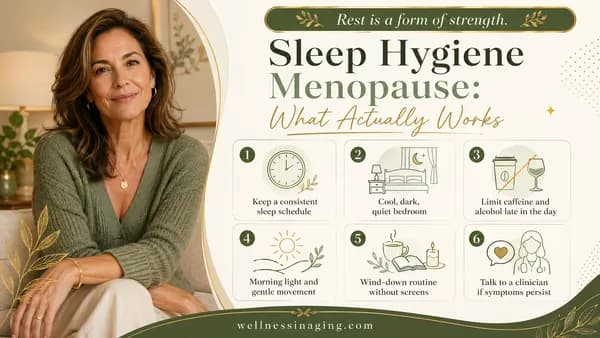
Sleep Hygiene Menopause: What Actually Works
Sleep hygiene menopause strategies that work: CBT-I, HRT, magnesium, and what doesn't. Evidence-rated guide with specific dosages and timelines.
Read article →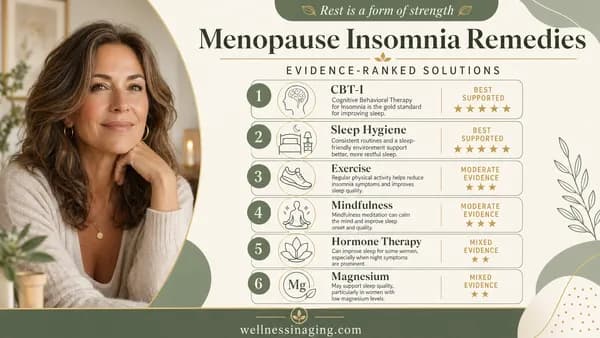
Menopause Insomnia Remedies: Evidence-Ranked Solutions
Evidence-ranked menopause insomnia remedies: magnesium, melatonin, cooling devices, and HRT. Learn specific dosages, timelines, and what to skip.
Read article →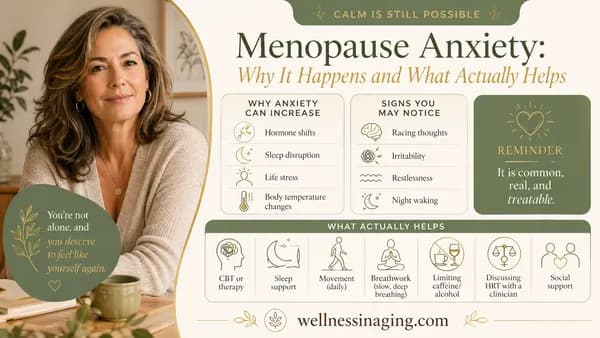
Menopause Anxiety: Why It Happens and What Actually Helps
Menopause anxiety affects up to 70% of perimenopausal women. Learn why it happens, evidence-ranked treatments, and when symptoms typically improve.
Read article →