
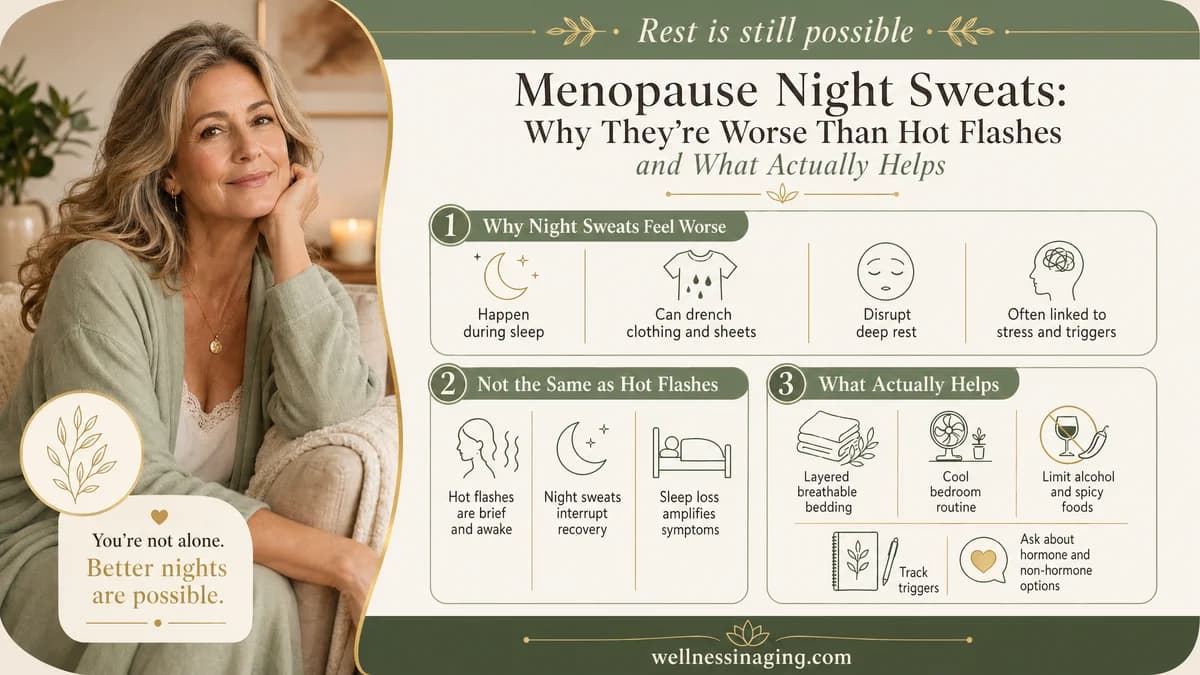
You woke up at 2:47 AM with your pillow soaked through. Again.
You kicked off the covers, then pulled them back 10 minutes later when the chill set in. That cycle — the one your doctor calls "vasomotor symptoms" and you call "exhausting" — affects roughly 80% of women going through menopause.
Here's what stops it, ranked by evidence strength.
The Mechanism: Same as Hot Flashes, Worse Consequences
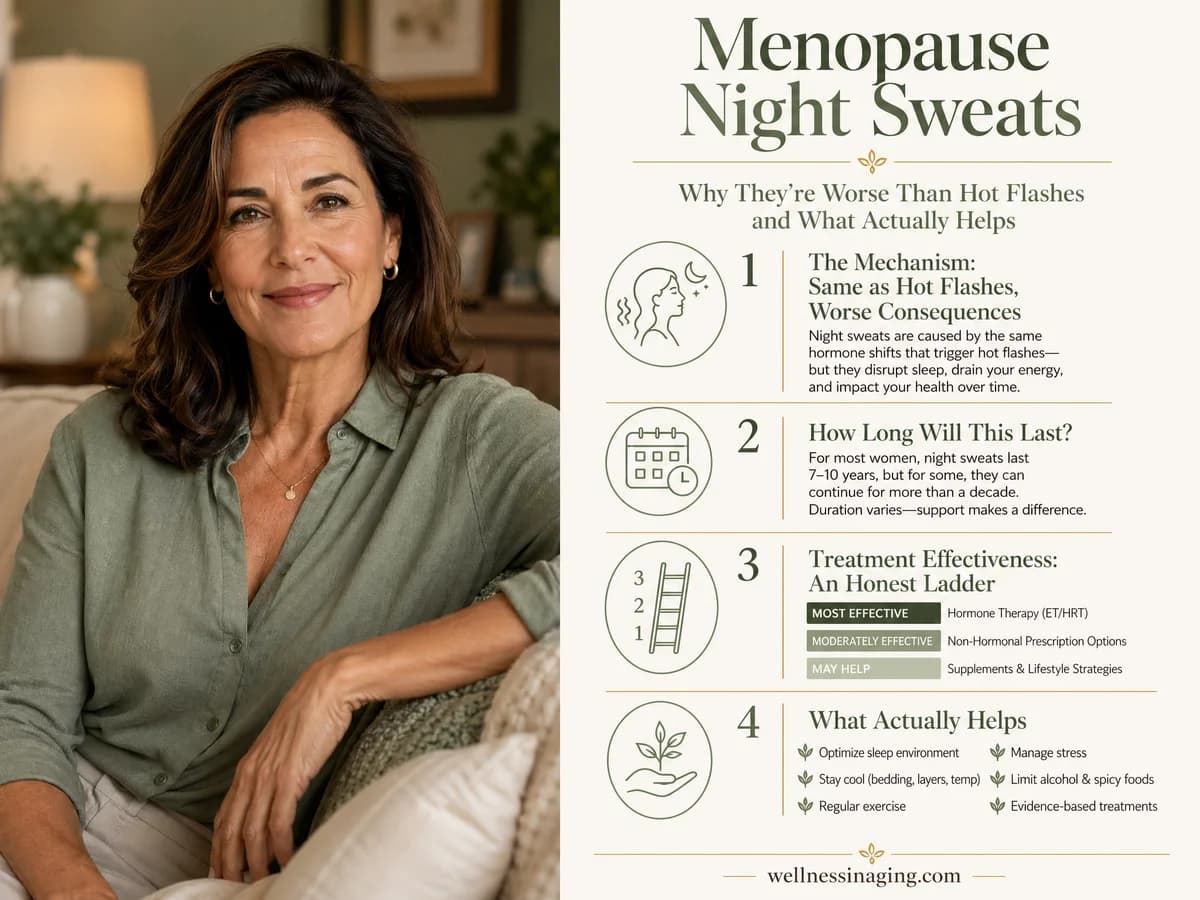
Night sweats are nocturnal hot flashes. The underlying physiology is identical: estrogen decline disrupts the hypothalamus's thermoregulatory function, narrowing the "thermoneutral zone" — the comfortable temperature range where your body doesn't need to actively heat or cool itself. (If you experience daytime episodes, see our complete guide to hot flashes for management strategies.)
In premenopausal women, the thermoneutral zone spans about 0.4°C. In postmenopausal women with significant VMS, it can narrow to nearly zero. Any tiny upward fluctuation in core body temperature — normal during sleep — triggers the heat-dissipation response: vasodilation (flushing) and sweating.
That's a night sweat.
So why do night sweats feel so much worse than daytime hot flashes?
You can't manage them in real time. During the day, a hot flash is uncomfortable but manageable — you can remove a layer, step outside, drink cold water. At night, you're asleep until you're already drenched.
They hit during REM. Core body temperature naturally rises during the second half of the night, roughly between 3am and 6am. This is exactly when REM sleep is most concentrated. A 2007 study by Freedman and Roehrs found that night sweats occurring during REM sleep caused significantly longer wake times than those during NREM — an average of 15 additional minutes awake per episode, often requiring getting out of bed entirely.
Sleep debt accumulates. Even three night sweats that each cause 15 minutes of waking means 45 fewer minutes of sleep per night. After a week, that's more than five hours. The cognitive and emotional effects of this kind of fragmented sleep — difficulty concentrating, irritability, low mood — look almost identical to the symptoms menopause itself is blamed for. Most women I've spoken with say the exhaustion is worse than the actual sweating. In many cases, the sleep deprivation is doing most of the damage. (For a complete protocol addressing menopause-specific sleep disruptions, see our menopause sleep hygiene guide.)
Is This Article For You?
This guide is designed for:
- Women experiencing night sweats during perimenopause or menopause who are waking 2+ times per night
- Those already trying basic interventions (fan, lighter bedding) without sufficient relief
- Anyone considering HRT but wanting to understand all options and their relative effectiveness
- Partners trying to understand what's happening and how to support without making it worse
This article is NOT for:
- Women experiencing night sweats with unexplained weight loss, fever, or other concerning symptoms — see "When to See a Doctor" section and consult a provider promptly
- Those looking for a single quick fix — night sweats typically require a layered approach
- Anyone expecting supplements alone to deliver HRT-level results — the evidence ladder matters
How Long Will This Last?
The honest answer is longer than most women are told. The SWAN study (Freeman et al., JAMA Internal Medicine, 2014) followed 255 women for up to 14 years and found the median duration of frequent VMS — including night sweats — was 7.4 years after the final menstrual period. Women who started having symptoms before their last period had an even longer median: 11.8 years.
Factors associated with longer duration:
- Earlier onset (symptoms beginning in perimenopause with regular cycles)
- Higher BMI
- Smoking
- African American ethnicity (the SWAN study found longer duration and greater severity in Black women)
- Higher baseline anxiety or depression scores
This isn't to discourage you — it's to help you make decisions. When you're staring down a potential decade of disrupted sleep, investing in a quality cooling mattress pad stops feeling like an indulgence and starts feeling rational. (Worth noting: the same sleep disruption mechanism contributes to menopause weight gain through cortisol dysregulation and reduced insulin sensitivity.)
Treatment Effectiveness: An Honest Ladder
Before getting into specifics, here's a realistic picture of what each category of intervention actually delivers.
| Treatment | Reduction in VMS Frequency/Severity | Evidence Rating | Notes |
|---|---|---|---|
| HRT (estrogen ± progesterone) | 75–90% | Strong | Most effective option; discuss candidacy and risks with provider |
| Fezolinetant (Veozah) | 60–65% | Strong | FDA-approved 2023; non-hormonal; requires liver monitoring |
| SSRIs/SNRIs (low-dose) | 40–60% | Strong | Good for women who can't use HRT; side effects possible |
| Gabapentin | 45% | Moderate | Sedating — can help sleep directly; take larger dose at bedtime |
| Black cohosh | 20–30% | Moderate | Mild-to-moderate symptoms only; takes 6–8 weeks |
| Soy isoflavones | 20–25% | Mixed | Depends on equol-producer status |
| Cooling bedding + environment | Varies | Moderate | Doesn't reduce VMS but reduces how much each episode disrupts sleep |
| Magnesium glycinate | Improves sleep, not VMS | Strong for sleep | Not a vasomotor treatment; helps return to sleep after waking |
| Vitamin E | ~1 episode/day reduction | Weak | Not worth the cardiovascular risk at effective doses |
The takeaway: If night sweats are significantly affecting your quality of life, the most important conversation you can have is with your healthcare provider about HRT candidacy. Everything below that row on the table is useful as a complement, not a substitute.
Bedding and Environment: The Practical Foundation
Cooling products don't stop night sweats from happening. They reduce how disruptive each episode is — how quickly your skin dries, how hot your sleep surface stays, how long it takes to get comfortable again. For many women, that's the difference between 20 minutes of waking and 45.
Room Temperature
Keep your bedroom at 60–67°F (15–19°C). Freedman and Roehrs (2007) found that every 2°F increase in ambient room temperature increased the frequency and duration of VMS-triggered waking. If your partner runs cold, a programmable thermostat that drops to 64°F at 11pm and rises at 6am is a reasonable compromise.
A ceiling fan or oscillating fan positioned to blow across the upper body helps enormously — moving air accelerates evaporation of sweat and feels cooling even at the same ambient temperature.
Sheets
This is where most women start, and the material genuinely matters.
What works:
- Bamboo viscose/rayon: Soft, moisture-wicking, temperature-regulating. Most women report this as the biggest improvement. Popular brands: Cozy Earth (pricey but very effective), Ettitude, Layla Bamboo.
- Tencel/lyocell: Technically from wood pulp; excellent moisture management, silky feel. Mid-price range.
- Performance fabric (SHEEX): Athletic moisture-wicking technology applied to bedding. Works well; less luxurious feel.
What to avoid:
- Standard cotton percale (absorbs moisture but doesn't wick — you end up sleeping on a damp surface)
- Flannel (excellent for cold nights; catastrophic for night sweats)
- Polyester blends (trap heat)
- High thread count (600+) sheets — denser weave means less airflow
Lower thread count actually helps. A 200–400 thread count bamboo sheet breathes better than a 600-count Egyptian cotton one. The bedding industry won't tell you this.
Mattress Pads and Cooling Systems
If bedding changes alone aren't enough, the next tier is active cooling.
Active water-cooled systems (highest effectiveness):
- ChiliSleep Dock Pro / OOLER: Water circulates through a pad at a set temperature. Each partner controls their own side independently. Cost: $600–1,200. Strong reviews for severe night sweats, particularly from women using it alongside HRT.
- BedJet v3: Blows temperature-controlled air directly under the sheets. Less even distribution than water systems but faster to set up. Cost: $350–600.
Passive phase-change material (PCM) pads:
- Slumber Cloud Dryline mattress pad: Absorbs body heat and releases it when you cool down. Cost: $150–280. Good middle ground for mild-to-moderate night sweats.
- Less dramatic than active systems but no tubes, no water, no noise.
Budget option: A breathable waterproof mattress protector (prevents mattress damage from repeated soaking) plus a cooling gel pillow covers the basics for under $100.
Sleepwear
Moisture-wicking pajamas (athletic fabric, not cotton) make a real difference. Soma Cool Nights and Lusomé make purpose-built options. Or simply switch to sleeping in less — whatever you're comfortable with. Tight synthetic materials are the worst option; they trap heat and prevent evaporation.
Keep a lightweight second set of pajamas and a dry towel folded on your nightstand. Being able to change quickly without fully waking yourself up — no hunting through drawers, no turning on lights — preserves sleep far better than you'd think. The 3am version of you will thank you.
The Pre-Sleep Window: What to Avoid
The 2–3 hours before bed can meaningfully affect night sweat frequency and severity.
- Alcohol is the single most consistent trigger people overlook. It causes peripheral vasodilation — exactly the same mechanism as a hot flash — and its metabolites disrupt sleep architecture in the second half of the night, precisely when night sweats are worst.
- Spicy food raises core body temperature and can lower the threshold for VMS.
- Heavy exercise within 2 hours of bed raises core temperature and may trigger nocturnal VMS in susceptible women. Morning or early afternoon exercise is better.
- Caffeine is less directly linked to VMS than alcohol but worsens sleep architecture if consumed after 2pm.
A warm (not hot) shower 60–90 minutes before bed can paradoxically help: it raises skin temperature, which triggers the body's natural cooling response, and core body temperature drops as you approach sleep, making it easier to stay asleep.
Supplements with Relevant Evidence
For more detail on each supplement, see our full guide to menopause supplements.
Magnesium glycinate (200–400mg, 1 hour before bed): The evidence is for sleep quality, not VMS reduction. Magnesium helps you fall back asleep after a night sweat, blunts the cortisol spike that extends waking, and improves deep sleep. It doesn't reduce night sweat frequency. For a complete breakdown of why glycinate is the preferred form for sleep and detailed dosing protocols, see our magnesium for menopause guide. Evidence for sleep: Strong. Evidence for VMS: Weak.
Black cohosh (40mg standardized extract, twice daily): The most-studied non-hormonal supplement for hot flashes and night sweats. Reduces VMS frequency by 20–30% in clinical trials — useful for mild-to-moderate symptoms, less helpful for severe cases. Takes 6–8 weeks. See our black cohosh guide for full dosage and safety information. Evidence: Moderate.
Soy isoflavones (50–90mg daily): Works for equol-producers (roughly 30–50% of Western women). If you try it for 10–12 weeks with no improvement, you're likely not an equol-producer and it won't help. Evidence: Mixed.
Paced Breathing: A Low-Tech Tool That Works
Freedman and Woodward (1992) published a now-classic behavioral study showing that slow paced breathing — 6–8 breaths per minute — reduced hot flash frequency by 44% in women who practiced it regularly. The mechanism involves reducing sympathetic nervous system activation that triggers the vasomotor response.
How to apply this to night sweats: Practice paced breathing for 10–15 minutes before sleep (there are phone apps with timed breath guidance). When you wake from a night sweat, start paced breathing immediately rather than lying there frustrated and staring at the ceiling. It won't cool you down faster, but it shortens the autonomic arousal period and helps you return to sleep 5–10 minutes sooner. At three episodes per night, that adds up.
What Doesn't Work for Night Sweats
This section matters as much as the rest. The night sweats market is full of products making claims that the evidence doesn't support. Spending money on these isn't just wasteful — it delays you from finding what actually helps.
Evening primrose oil: A 1994 double-blind RCT by Chenoy et al. found no significant reduction in hot flash or night sweat frequency or severity compared to placebo. It shows up in dozens of "menopause blend" supplements anyway. It isn't earning its place there.
Valerian root for night sweats: Valerian has modest evidence for general sleep quality (not falling asleep faster, but subjective sleep quality ratings). It has no evidence for reducing VMS frequency. Don't confuse "may help you feel like sleep was better" with "reduces night sweats."
Melatonin for vasomotor symptoms: Melatonin addresses circadian rhythm disruption and may help with sleep initiation. It does not reduce the frequency or intensity of night sweats. It's a useful supplement for jet lag and sleep-phase issues — it's not a VMS treatment.
Cooling sprays and topical treatments during episodes: These feel good in the moment. There's no evidence they reduce episode severity, duration, or frequency. They're comfort products, not treatments.
Progesterone cream (over-the-counter): OTC progesterone creams contain wild yam extract, not bioidentical progesterone — the body cannot convert diosgenin to progesterone. Prescription-strength bioidentical progesterone is a different matter and requires a healthcare provider conversation.
General "menopause blend" supplements: Most of these combine low doses of black cohosh, red clover, dong quai, and evening primrose oil at concentrations below those used in clinical trials. Individual ingredients at clinical doses may have evidence; proprietary blends at sub-therapeutic doses almost never do.
When to See a Doctor About Night Sweats
Night sweats are usually a menopause symptom — but not always. See a provider promptly if your night sweats are accompanied by any of the following:
- Unexplained weight loss (more than 5% of body weight in 6 months) — possible lymphoma or other malignancy
- Persistent fever — infection, including tuberculosis
- Symptoms of hyperthyroidism — heart palpitations, heat intolerance, unintentional weight loss, tremor, anxiety. Ask for a TSH test.
- Snoring, gasping, or daytime sleepiness — possible obstructive sleep apnea, which worsens significantly in menopause as progesterone declines
- Night sweats that began after age 60 — menopause VMS typically begins in the 40s–50s; late-onset night sweats warrant evaluation
- Night sweats while on tamoxifen or SSRIs — medication-induced; discuss dose or alternatives with your prescriber
The Partner Factor
Night sweats don't only affect you. The temperature disruptions, bedding changes, and waking affect whoever sleeps next to you — and the relationship stress of disrupted sleep is real.
Practical accommodations that help:
- Separate duvets, same bed. Each person controls their own temperature without disturbing the other when covers are thrown off and reclaimed.
- Split king setup with individual cooling controls — a significant investment if night sweats are severe and long-lasting.
- Acknowledging the disruption openly. Partners who understand what's happening (mechanistically, not just "she's hot at night") are far more patient than those left guessing.
A brief, honest conversation — "This is a physiological symptom that will likely last a few years, here's what it looks like from my side" — prevents months of low-grade resentment that neither person can name.
Next Steps: Building Your Night Sweats Strategy
Night sweats fragment sleep for years — but they don't have to control your life. The evidence-based approach is layered: start with cooling bedding and environment control, add targeted supplements if appropriate, and have an honest conversation with your healthcare provider about HRT candidacy if symptoms are moderate to severe.
The women who manage this best aren't the ones who find a single magic solution — they're the ones who build a system that addresses sleep disruption from multiple angles and adjusts as symptoms change over time.
Free Resource: Download the Menopause Starter Guide — practical information on symptoms, the supplements with the strongest evidence, and a doctor's appointment checklist to make the most of your next healthcare visit.
Want evidence-based menopause information delivered weekly? Subscribe to our newsletter for practical guides, new research summaries, and reader Q&As.
Download the Menopause Starter Guide →
References
- Kravitz HM et al. (2008). "Sleep disturbance during the menopausal transition in a multi-ethnic community sample of women." Sleep, 31(7): 979–990.
- Freedman RR, Roehrs TA (2007). "Effects of REM sleep and ambient temperature on hot flash-induced sleep disturbance." Menopause, 14(3 Pt 1): 374–381.
- Freeman EW et al. (2014). "Duration of menopausal hot flushes and associated risk factors." JAMA Internal Medicine, 174(7): 1171–1179.
- Joffe H et al. (2013). "Impact of estradiol variability and progesterone on mood in perimenopausal women with depressive symptoms." Journal of Clinical Endocrinology and Metabolism, 98(2): E321–326.
- Freedman RR (2014). "Menopausal hot flashes: mechanisms, endocrinology, treatment." Mayo Clinic Proceedings, 89(9): 1287–1294.
- Freedman RR, Woodward S (1992). "Behavioral treatment of menopausal hot flushes." American Journal of Obstetrics and Gynecology, 167(2): 436–439.
- Young T et al. (2003). "Sleep disordered breathing and menopause." American Journal of Respiratory and Critical Care Medicine, 167(9): 1181–1185.
- Abbasi B et al. (2012). "The effect of magnesium supplementation on primary insomnia in elderly." Journal of Research in Medical Sciences, 17(12): 1161–1169.
- Osmers R et al. (2005). "Efficacy and safety of isopropanolic black cohosh extract for climacteric symptoms." Obstetrics and Gynecology, 105(5): 1074–1083.
Free Download
The Menopause Starter Guide
Evidence-rated strategies, a supplement reference, and a symptom tracker. 12 pages, free.
Related Articles
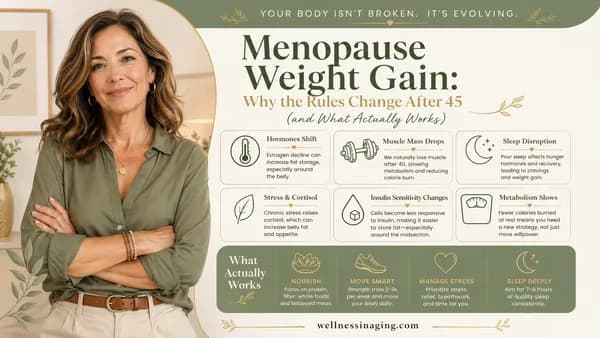
Menopause Weight Gain: Why the Rules Change After 45 (and What Actually Works)
Why menopause causes belly fat even when weight stays stable — the hormonal mechanism behind visceral fat redistribution and evidence-based strategies that work differently after 45.
Read article →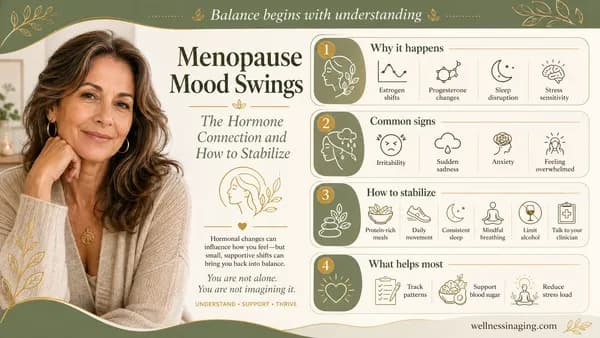
Menopause Mood Swings: The Hormone Connection and How to Stabilize
Why estrogen fluctuations cause dramatic mood changes during menopause — and evidence-based approaches from lifestyle to supplements to therapy.
Read article →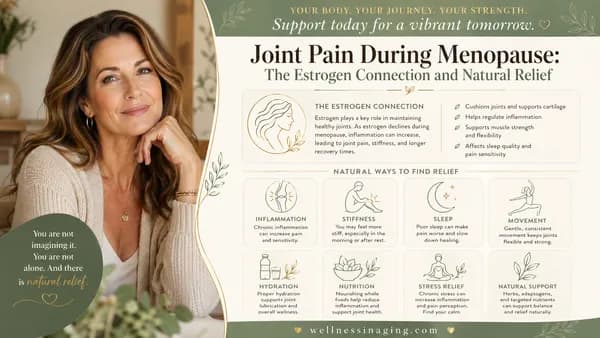
Joint Pain During Menopause: The Estrogen Connection and Natural Relief
Why declining estrogen causes joint pain during menopause — and which supplements, exercises, and lifestyle changes have clinical evidence behind them.
Read article →