
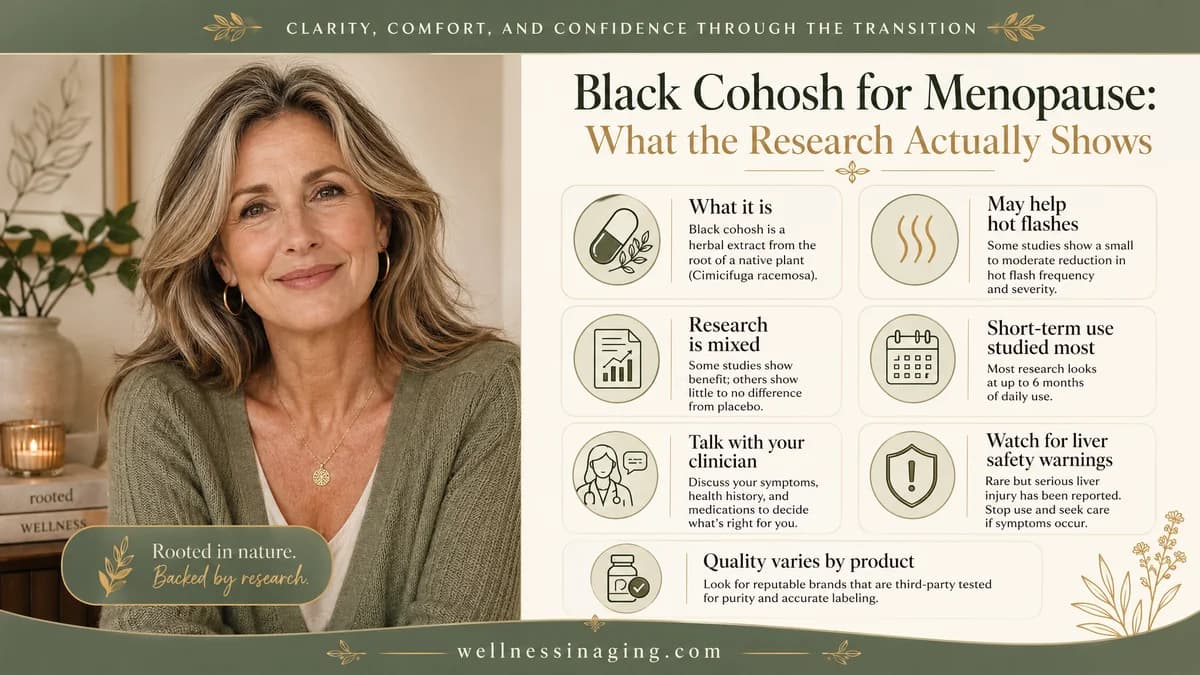
Free Download: Menopause Starter Guide — Evidence-based strategies for managing symptoms, a supplement reference, and a symptom tracker to bring to your doctor.
Download the Menopause Starter Guide →
Your friend swears by black cohosh. Your sister says it did nothing. Online, you'll find studies that seem to support both of them.
The research on black cohosh for hot flashes is genuinely mixed — and understanding why tells you whether it's worth trying. More importantly, which form and dose were used in the trials that actually showed benefit.
Some well-designed trials show meaningful benefit. Others show none. A small but serious body of case reports links black cohosh to liver injury.
If you're trying to decide whether black cohosh is worth taking — how to take it, what to expect, and whether it's safe — here's what the research shows.
The short version: Black cohosh provides modest, real benefit for mild-to-moderate hot flashes in a portion of women who take it. It is not remotely as effective as hormone therapy. It takes 6–8 weeks to work. The liver risk is rare but not zero. And the brand and extraction method matter more than most people realize.
What Black Cohosh Is (and Is Not)
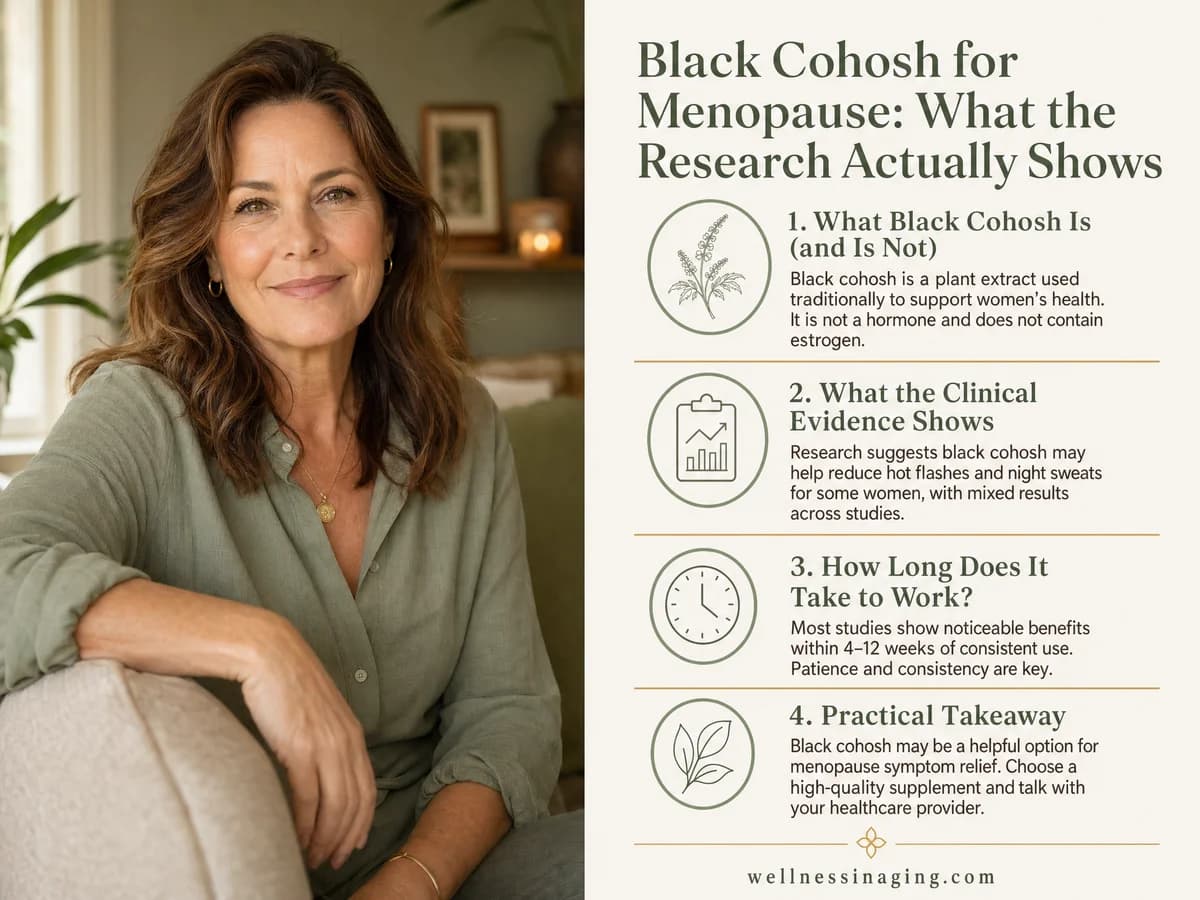
Black cohosh (Actaea racemosa, also called Cimicifuga racemosa) is a flowering plant native to eastern North America. The root and rhizome are used medicinally. Its active constituents include triterpene glycosides (particularly actein and deoxyactein), which are thought to be responsible for its clinical effects.
For years, researchers assumed black cohosh worked like a phytoestrogen — a plant compound that mimics estrogen in the body. That assumption has been largely overturned. Multiple analyses have found that black cohosh does not bind estrogen receptors with meaningful affinity and does not produce estrogenic effects on breast or uterine tissue (Borrelli & Ernst, Pharmacological Research, 2008).
The current theory points to a different mechanism: black cohosh appears to modulate serotonin receptors in the hypothalamus — the part of the brain that regulates body temperature — as well as dopamine receptors involved in the thermoregulatory system. This explains why it may reduce hot flash frequency without acting as an estrogen.
Why this matters: Because black cohosh is not estrogenic, it may be an option for women who've been told to avoid estrogen-containing treatments (including women with a history of certain hormone-sensitive cancers). That said, this remains an active area of debate. Anyone in that situation should discuss it with their oncologist before taking black cohosh.
What the Clinical Evidence Shows
Evidence rating: MODERATE
The evidence base for black cohosh is larger than for most herbal menopause remedies — and more honest about its limitations.
The positive trials
The most rigorous positive trial is Osmers et al. (2005), a randomized, double-blind, placebo-controlled study of 304 women with menopausal symptoms. Women received Remifemin (a standardized isopropanolic black cohosh extract) at 80mg/day or placebo for 12 weeks. The result: hot flash frequency dropped approximately 26% more than placebo. Night sweats showed similar improvement. No estrogenic effects were detected on the endometrium or breast tissue.
A 2003 head-to-head trial by Wuttke et al. compared black cohosh extract directly to conjugated estrogens and placebo in 62 postmenopausal women. Both active treatments outperformed placebo on menopausal symptom scores; black cohosh also showed favorable effects on bone resorption markers.
A 2010 meta-analysis by Shams et al. pooled 9 randomized controlled trials involving over 2,000 women. The finding: statistically significant but modest benefit for vasomotor symptoms, with effect sizes in the small-to-medium range (Cohen's d ~0.3–0.4). Better results consistently appeared with standardized isopropanolic extracts.
The neutral and negative trials
The HALT Study (Newton et al., Annals of Internal Medicine, 2006) is the trial most often cited against black cohosh. It enrolled 351 women over 12 months, testing black cohosh at 160mg/day against multibotanical, soy, hormone therapy, and placebo. Black cohosh alone was not significantly better than placebo.
The HALT Study used a different preparation than the European trials and a higher dose — suggesting the form and extraction method may be as important as the ingredient itself.
The 2012 Cochrane review of 16 randomized trials concluded that evidence was "limited" for black cohosh over placebo — though "limited" in Cochrane language means inconsistent across studies, not absent. The variability in study quality, dosing, and product formulations drove most of the heterogeneity.
What the inconsistency actually means
The studies don't contradict each other at random. There's a pattern:
- Trials using standardized isopropanolic extract (the Remifemin formulation) tend to show modest but real benefit
- Trials using non-standardized root powder or different extraction methods tend to show no benefit
- Shorter trials (under 8 weeks) often miss the therapeutic window entirely
- Trials in breast cancer survivors show weaker results, possibly because that population responds differently or because 20mg BID doses were too low
This suggests that black cohosh works for some women, using specific formulations, given enough time — and that the inconsistent results reflect product quality and study design as much as the herb's effectiveness.
How Long Does It Take to Work?
This is the most practically important piece of information that most supplement labels and health websites omit entirely.
| Timeframe | What to Expect |
|---|---|
| Weeks 1–2 | No noticeable change. This is normal. Do not stop. |
| Weeks 3–4 | Some women notice subtle reduction in intensity. Still not peak effect. |
| Weeks 6–8 | If black cohosh is going to work for you, you'll know by now. Expect 20–30% reduction in hot flash frequency — not elimination. |
| Months 3–6 | Sustained benefit for those who respond. Re-evaluate if no improvement by week 8. |
| Beyond 6 months | Some evidence suggests benefits may diminish after 6–12 months of continuous use. Worth reassessing. |
The most common reason women conclude that black cohosh "doesn't work" is quitting after two weeks. A fair trial is 8 weeks minimum.
Tracking tip: Count your hot flashes daily for the two weeks before starting black cohosh. Count again at week 6–8. A 20% or greater reduction is a meaningful response. Less than that, and the herb isn't working for you.
Dosage and What to Look for on the Label
Recommended dose: 40mg standardized extract twice daily (80mg total per day)
The standardization that matters: 2.5% triterpene glycosides, or 1mg deoxyactein per dose. This is what most positive clinical trials used.
Extraction method: Isopropanolic extraction (sometimes listed as "isopropanol extract" or "hydroethanolic extract") appears to produce more consistent clinical results than aqueous (water-based) extraction or simple root powder. When the extraction method isn't listed, that's not necessarily disqualifying — but it's a gap.
What to look for on the label:
- Actaea racemosa or Cimicifuga racemosa extract (not just "root powder")
- Standardized to 2.5% triterpene glycosides
- 40mg or 80mg per tablet/capsule
The Remifemin question: Remifemin is the brand used in most of the positive clinical trials. It uses a German pharmaceutical-grade standardization process and has the strongest evidence base of any commercial product. It costs more than generic black cohosh. Whether the premium is worth it depends on your priorities — if you've tried generic black cohosh without results, it's reasonable to try Remifemin specifically before concluding the herb doesn't work for you.
Acceptable generic alternatives include Nature's Way and Gaia Herbs, if they meet the standardization criteria above. Check the label before buying.
Safety and the Liver Question
Black cohosh has a generally favorable safety profile. Common side effects are mild:
- GI upset or nausea (5–10% of users) — taking it with food reduces this significantly
- Headache (uncommon)
- Dizziness (uncommon)
- Rash or allergic reaction (rare)
The liver concern
There are approximately 30–40 case reports worldwide of liver injury associated with black cohosh use, including a small number of severe cases. The European Medicines Agency reviewed these reports in 2006 and concluded that a causal link was possible but not definitively established — many cases involved polyherbal products or other confounding factors. The United States Pharmacopeia (2008) reached a similar conclusion: "possible but not certain."
Serious liver toxicity is rare — estimated at less than 1 in 10,000 users — and may be higher with non-standardized or contaminated products. Possible mechanisms include contaminants, adulteration with other Cimicifuga species, or an idiosyncratic reaction in susceptible individuals.
Stop taking black cohosh and contact your doctor if you notice:
- Yellowing of skin or whites of the eyes (jaundice)
- Dark urine
- Light-colored stools
- Pain in the upper right abdomen
- Unusual fatigue or nausea
Contraindications:
- Liver disease or history of hepatitis — do not use
- Pregnancy or breastfeeding — insufficient safety data
- Allergy to black cohosh or the buttercup plant family
Use in breast cancer survivors
Because black cohosh appears to be non-estrogenic, it does not stimulate breast tissue or estrogen-receptor-positive cancer cells in vitro or in animal models. Small clinical studies in breast cancer survivors have not shown safety concerns. The data are limited, though. Women with a history of breast cancer should discuss black cohosh specifically with their oncologist before taking it.
Drug Interactions
Black cohosh may inhibit certain cytochrome P450 enzymes (CYP2D6 and CYP3A4), which process many common medications. Most interactions are theoretical — based on lab studies rather than confirmed clinical cases — but caution is appropriate if you take:
- Statins (atorvastatin, simvastatin)
- Certain beta-blockers (metoprolol)
- SSRIs or SNRIs (paroxetine, fluoxetine, venlafaxine)
- Chemotherapy agents, particularly tamoxifen
- Immunosuppressants (cyclosporine)
Tell your prescribing doctor and pharmacist you're taking black cohosh. This is especially important for tamoxifen — the clinical evidence of a problematic interaction is limited, but the theoretical concern is real enough to warrant the conversation.
How It Compares to Other Options
| Treatment | Hot Flash Reduction | Evidence | Cost/Month | Notes |
|---|---|---|---|---|
| HRT (estrogen-based) | 75–90% | Strong | $10–100 | Most effective; prescription only |
| Fezolinetant (Veozah) | 60–65% | Strong | $500+ | FDA-approved non-hormonal; prescription |
| SSRIs/SNRIs (low-dose) | 40–60% | Strong | $10–40 | Sexual side effects possible |
| Soy isoflavones | 20–50% | Moderate | $15–30 | Works best in equol-producers |
| Black cohosh | 20–30% | Moderate | $15–40 | 8-week trial needed |
| Evening primrose oil | Minimal | Insufficient | $10–20 | Not recommended for hot flashes |
Black cohosh is a reasonable choice for women with mild-to-moderate hot flashes who prefer to avoid or are ineligible for hormone therapy, who have realistic expectations about the degree of relief, and who are willing to give it at least 8 weeks. It is not a substitute for HRT if symptoms are severe enough to significantly disrupt sleep or daily functioning.
Black cohosh can be taken alongside HRT — there's no known negative interaction — though it adds little if HRT is already managing symptoms adequately.
What Black Cohosh Won't Fix
Being honest about limitations builds trust — and prevents you from wasting months on a remedy that can't address your specific symptoms.
Vaginal dryness and genitourinary symptoms. Black cohosh has no meaningful evidence for vaginal atrophy, dryness, or urinary symptoms. These issues result from estrogen loss in local tissue, and black cohosh doesn't act as an estrogen. If vaginal dryness is your primary concern, topical estrogen (low-dose vaginal cream or ring) or non-hormonal vaginal moisturizers are far more effective. The 2017 NAMS position statement confirms that systemic herbal remedies do not address genitourinary syndrome of menopause.
Sleep disruption caused by night sweats. Black cohosh may modestly reduce the frequency of night sweats themselves, but if night sweats are the primary driver of your insomnia, treating them directly — cooling strategies, bedding changes, or HRT — outperforms black cohosh. The 20–30% reduction in vasomotor symptoms isn't enough to fix sleep that's broken four or five times per night.
Mood symptoms and depression. Early studies suggested black cohosh might improve mood and anxiety during menopause. However, the 2012 Cochrane review and subsequent meta-analyses have not confirmed clinically meaningful effects on mood or depression scores. If you're experiencing significant anxiety or depressive symptoms during perimenopause, SSRIs, SNRIs, or cognitive behavioral therapy have stronger evidence.
Bone density. One small trial (Wuttke et al., 2003) showed favorable markers of bone resorption, but no follow-up research has confirmed that black cohosh prevents or slows bone loss. There is no evidence it protects against osteoporosis. Standard interventions — weight-bearing exercise, calcium, vitamin D, and bisphosphonates if indicated — remain the evidence-based approach.
Long-duration relief. Most clinical trials ran 3–6 months. Evidence for sustained benefit beyond 6 months is limited. Some women report diminished effectiveness after prolonged use, though this hasn't been systematically studied. Reassess periodically if you've been taking black cohosh for more than 6 months.
Who it clearly doesn't work for:
- Women with hormone-sensitive cancer history — safety data is limited and conflicting; the non-estrogenic mechanism is reassuring but not conclusive enough to recommend use without oncologist approval
- Women with liver conditions — rare but documented hepatotoxicity risk; the European Medicines Agency and USP have flagged this concern
- Women expecting rapid relief — if you need symptom control within days, not weeks, black cohosh is the wrong tool
Is Black Cohosh Right for You?
This article is for you if:
- You have mild-to-moderate hot flashes (roughly 5–10 per day)
- You prefer a non-hormonal, over-the-counter option
- You have no liver disease or history of hepatitis
- You're willing to commit to at least 8 weeks to see if it works
- You want an evidence-based herbal option with real clinical data
This probably isn't what you're looking for if:
- Your hot flashes are severe (15+ per day, or consistently waking you up multiple times per night) — you likely need HRT or prescription non-hormonal therapy
- You have liver disease or abnormal liver enzymes
- You're expecting something close to HRT-level relief (75–90% reduction)
- You want something that works within days — black cohosh takes 6–8 weeks
- You're taking tamoxifen or other medications with potential CYP450 interactions — talk to your doctor first
Ready to Try Black Cohosh?
Start here: Download our free Menopause Starter Guide for dosage protocols, brand comparisons, and a tracking template to measure your results over 8 weeks.
Need the product now? Remifemin and Nature's Way Black Cohosh both meet the clinical standardization criteria discussed in this article.
This content is for informational purposes only and does not constitute medical advice. Always consult with a qualified healthcare provider before starting any new supplement or treatment. Individual results may vary.
Related Reading
- Magnesium for Menopause — pairs well with black cohosh for sleep disrupted by night sweats
- HRT vs Natural Remedies — full evidence comparison if you're weighing both options
- Best Menopause Supplements 2026 — where black cohosh fits in a broader supplement strategy
- Night Sweats During Menopause — companion symptom guide
References
- Osmers R, et al. (2005). "Efficacy and safety of isopropanolic black cohosh extract for climacteric symptoms." Obstetrics & Gynecology, 105(5): 1074–1083.
- Shams T, et al. (2010). "Efficacy of black cohosh-containing preparations on menopausal symptoms: a meta-analysis." Alternative Therapies in Health and Medicine, 16(1): 36–44.
- Leach MJ, Moore V. (2012). "Black cohosh (Cimicifuga spp.) for menopausal symptoms." Cochrane Database of Systematic Reviews, 9: CD007244.
- Newton KM, et al. (2006). "Treatment of vasomotor symptoms of menopause with black cohosh, multibotanicals, soy, hormone therapy, or placebo." Annals of Internal Medicine, 145(12): 869–879.
- Borrelli F, Ernst E. (2008). "Black cohosh (Cimicifuga racemosa) for menopausal symptoms: a systematic review of its efficacy." Pharmacological Research, 58(1): 8–14.
- Reame NE, et al. (2008). "Black cohosh has central opioid activity in postmenopausal women." Menopause, 15(5): 832–840.
- Wuttke W, et al. (2003). "The Cimicifuga preparation BNO 1055 vs. conjugated estrogens in a double-blind placebo-controlled study." Maturitas, 44 Suppl 1: S67–77.
- United States Pharmacopeia. (2008). "Black cohosh safety review." USP Safety Evaluation Program.
- Mehrpooya M, et al. (2018). "A comparative study on the effect of black cohosh and evening primrose oil on menopausal symptoms." International Journal of Pharmaceutical Research, 17(3): 1634–1645.
Free Download
The Menopause Starter Guide
Evidence-rated strategies, a supplement reference, and a symptom tracker. 12 pages, free.
Related Articles
Probiotics and Menopause: The Gut-Hormone Connection (What the Science Says)
Your gut bacteria directly regulate estrogen metabolism through the estrobolome. Here's what probiotics can and can't do for menopause — with strain-specific evidence for bone health, mood, and vaginal health.
Read article →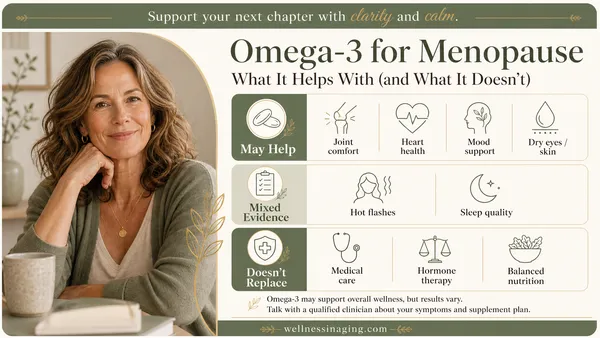
Omega-3 for Menopause: What It Helps With (and What It Doesn't)
Omega-3s have strong evidence for mood, joint pain, and heart health during menopause — but NOT for hot flashes. Here's the RCT data, the correct EPA vs DHA dose by symptom, and how to avoid rancid fish oil.
Read article →
Maca Root for Menopause: Does It Actually Work? (The Evidence)
Maca root is widely promoted for menopause. Here's what the RCTs actually show — what it helps with (libido, mood), what it doesn't (hot flashes), and the correct dose.
Read article →