
Free Download: Menopause Starter Guide — Evidence-based strategies for managing symptoms, a supplement reference, and a symptom tracker to bring to your doctor.
Download the Menopause Starter Guide →
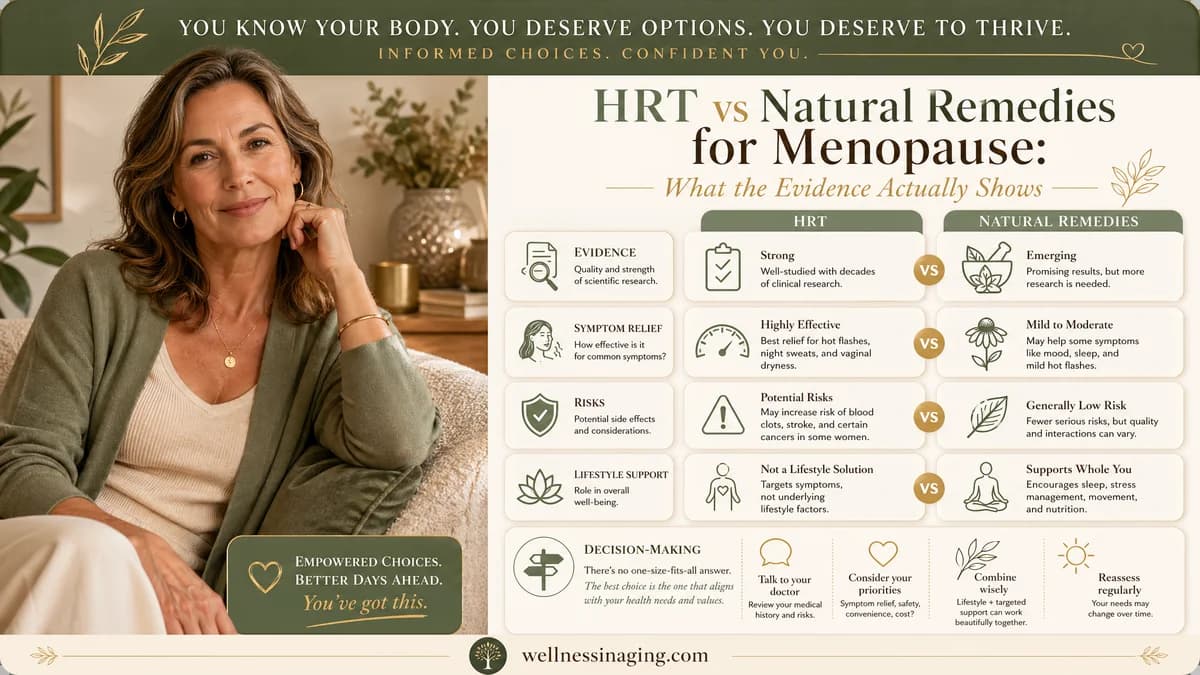
HRT or natural remedies — the internet makes it sound like you have to pick a side. You don't.
The real question isn't which camp you're in. It's which symptoms you're treating, how severe they are, and what your personal risk factors look like. This guide maps the evidence for both, without assuming you've already decided.
Women who want HRT are sometimes told by cautious doctors that it's too dangerous. Women who prefer natural approaches are sometimes dismissed as naive. Both camps are dealing with a misrepresentation of what the research shows.
This guide doesn't have a position on which choice is right for you. That depends on your symptoms, your health history, your risk profile, and your values. What it does have: honest evidence. What each approach does, by how much, for which symptoms, and at what cost.
The WHI Study Problem (Read This First)

If you're scared of HRT because of headlines you remember from 2002 or 2003, you're not alone — and you deserve to know what the Women's Health Initiative study actually found, because it's been widely misinterpreted for more than 20 years.
The original WHI study enrolled postmenopausal women with an average age of 63 — many of them 10–20 years past their final period — and gave them oral conjugated equine estrogen plus synthetic progestin (medroxyprogesterone acetate). The study was halted early when researchers detected a small increase in breast cancer, stroke, and cardiovascular events in the hormone group.
What was not widely reported at the time:
- Women who started HRT under age 60 or within 10 years of menopause had different results — reduced cardiovascular risk, not increased
- The estrogen-only arm of the WHI (for women without a uterus) showed no increased breast cancer risk — and possibly a slight decrease
- The synthetic progestin used (medroxyprogesterone acetate) carries higher risk than micronized progesterone (bioidentical), which is now commonly prescribed
- The absolute risk increases were small — 1 additional case of breast cancer per 1,000 women per year, not the dramatic numbers implied by relative risk reporting
A 2017 reanalysis by Manson et al. in JAMA, pooling all WHI data, found that overall mortality was actually lower in the HRT groups during the trial period. The picture is more nuanced — and more favorable — than 2002 headlines suggested.
This context matters because millions of women stopped HRT based on the original headlines, suffered through unnecessary years of symptoms, and were denied a treatment that the evidence now shows is safe and beneficial for most women under 60 without contraindications.
Head-to-Head: How Effective Is Each Approach by Symptom?
| Symptom | HRT Efficacy | Best Natural Option | Natural Efficacy |
|---|---|---|---|
| Hot flashes / night sweats | 75–90% reduction | Black cohosh, soy isoflavones | 20–50% reduction |
| Vaginal dryness / painful sex | 90%+ improvement | Vaginal moisturizers, sea buckthorn oil | 30–50% improvement |
| Sleep disruption | 60–80% improvement | Magnesium, CBT-I, sleep hygiene | 40–60% improvement |
| Mood / anxiety | 50–70% improvement | Exercise, omega-3s, magnesium | 30–50% improvement |
| Bone density loss | Prevents + reverses 5–10% | Calcium + vitamin D + exercise | Slows loss; does not reverse |
| Brain fog / cognition | 40–60% improvement | Exercise, omega-3s, sleep | 20–40% improvement |
| Libido / sexual function | 50–70% (esp. with testosterone) | Lifestyle factors | 10–30% improvement |
| Cardiovascular risk | Reduces risk (if started early) | Mediterranean diet, exercise | Reduces risk |
HRT wins on efficacy for every symptom category. The question is never "which works better" — it's "is the efficacy difference large enough to justify the risk profile given my personal circumstances?"
HRT: What the Evidence Shows
Benefits
Vasomotor symptoms (hot flashes, night sweats) HRT reduces moderate-to-severe hot flashes by 75–90%. No other treatment comes close. This is not a modest advantage — it is a 3-to-4-fold difference in effectiveness compared to the best natural remedies. Source: NAMS 2022 Position Statement; Cochrane Review 2015.
Genitourinary syndrome of menopause (GSM) Vaginal atrophy, dryness, and painful intercourse respond dramatically to vaginal estrogen — 90%+ of women report improvement. Vaginal estrogen (cream, suppository, ring) stays local and has negligible systemic absorption, making it extremely safe even for many women who can't take systemic HRT. Source: NAMS 2020 GSM Position Statement.
Bone density HRT prevents postmenopausal bone loss and reduces fracture risk by 30–40%. The effect lasts as long as treatment continues. This is an FDA-approved indication. Source: Manson et al., JAMA 2017.
Cardiovascular protection (early initiation) Women who start HRT under age 60 or within 10 years of menopause have approximately 30% lower coronary artery disease risk. Estrogen protects healthy arterial walls — but the protective effect is absent or reversed in women with existing arterial plaque. The "timing window" matters. Source: Manson et al., NEJM 2016; Danish Osteoporosis Prevention Study.
Mood and perimenopausal depression Estrogen modulates serotonin, dopamine, and GABA. Perimenopausal depression — distinct from major depressive disorder — responds particularly well to estrogen therapy. Source: Soares et al., Archives of General Psychiatry 2001.
Risks (with context)
Breast cancer This is the most feared risk and the most often misrepresented. Here's the nuanced picture:
- Estrogen-only HRT (for women without a uterus): No increased breast cancer risk. The WHI estrogen-only arm showed a 23% lower invasive breast cancer rate than placebo.
- Estrogen + progestogen HRT: Small increased risk after 5+ years. The absolute increase is approximately 1 additional case per 1,000 women per year — smaller than the risk from drinking 2+ alcoholic drinks daily, being obese, or having never had children.
- Type of progestogen matters: Synthetic progestins (medroxyprogesterone acetate) carry higher breast cancer risk than micronized progesterone (bioidentical). If you take combination HRT, ask for micronized progesterone (brand name: Prometrium).
Source: Collaborative Group on Hormonal Factors in Breast Cancer, Lancet 2019; WHI reanalysis 2017.
Blood clots (VTE) Oral estrogen increases VTE risk 2–3x. Transdermal estrogen (patches, gels) does NOT increase VTE risk — it bypasses the liver, avoiding the clotting cascade activation that oral estrogen triggers. If you have obesity, a clotting history, or other VTE risk factors, transdermal is strongly preferred over oral. Source: ESTHER Study, Canonico et al., BMJ 2008.
Stroke Small increased risk with oral estrogen (approximately 1.3x relative risk; about 1 additional case per 1,000 women per year). Transdermal may carry lower stroke risk. Risk is higher if HRT is started after age 60 or 10+ years post-menopause. Source: WHI 2017.
Endometrial cancer Estrogen-only HRT dramatically increases uterine cancer risk in women with an intact uterus. This is why progestogen is required for women who have not had a hysterectomy — it fully protects the uterine lining and eliminates this risk.
Who is a good HRT candidate?
Strong candidates (high benefit, lower relative risk):
- Age under 60 or within 10 years of final menstrual period
- Moderate-to-severe vasomotor symptoms affecting sleep or quality of life
- No personal history of breast cancer, blood clots, stroke, or active liver disease
- No current heart disease
- Bothersome vaginal symptoms (GSM)
- Concerns about bone health or low bone density
Contraindications (do not use systemic HRT):
- Personal history of breast cancer or other hormone-sensitive cancer
- History of blood clots (DVT or pulmonary embolism) or clotting disorder
- History of stroke or heart attack
- Active liver disease
- Unexplained vaginal bleeding
Note on vaginal estrogen: Women with contraindications to systemic HRT may still be candidates for local vaginal estrogen, which has minimal systemic absorption. This is worth discussing with your doctor separately.
Natural Remedies: What the Evidence Shows
What works (with ratings)
Soy isoflavones | Evidence: MODERATE–STRONG A 2012 meta-analysis by Taku et al. pooled 19 RCTs and found soy isoflavones reduced hot flash frequency by 20–50% (dose-dependent). Higher doses (50–100mg/day) outperformed lower doses. Effect takes 6–12 weeks to appear. Works best in women who produce equol (a soy metabolite) — roughly 30–50% of Western populations. Dietary soy (edamame, tofu, tempeh) works at least as well as supplements.
Black cohosh | Evidence: MODERATE Meta-analysis of 9+ RCTs shows modest but real benefit — approximately 20–30% reduction in hot flash frequency vs placebo with standardized isopropanolic extract. Takes 6–8 weeks. Does not work for severe vasomotor symptoms. See our full black cohosh guide for dosage, brand guidance, and the liver safety question.
Magnesium | Evidence: MODERATE (sleep, mood) | WEAK (hot flashes) Magnesium glycinate at 200–400mg before bed meaningfully improves sleep quality and reduces anxiety — both indirect contributors to menopause quality of life. Its effect on hot flash frequency is minimal. Worth taking for sleep and mood regardless of other strategies.
Omega-3 fatty acids | Evidence: MODERATE Modest hot flash reduction (approximately 1.6 fewer per day vs placebo in one RCT). Stronger evidence for mood, cardiovascular health, and cognitive support. 1000–2000mg combined EPA+DHA daily.
Exercise | Evidence: STRONG (mood, bone, sleep) | MODERATE (hot flashes) Exercise is the closest thing to a universal menopause intervention. It's as effective as antidepressants for mild-to-moderate depression, preserves bone density, improves sleep, and supports cardiovascular health. Its effect on hot flash frequency is modest and inconsistent — but its effect on everything surrounding hot flashes is strong.
Paced breathing (slow, deep, 6–8 breaths/min) | Evidence: MODERATE RCT evidence shows paced respiration reduces hot flash intensity by 40–50% — not frequency, but how severe each one feels. Free, immediately applicable, and worth practicing before reaching for supplements.
What doesn't work
Evening primrose oil: Multiple RCTs show no benefit for hot flashes. Popular but ineffective for vasomotor symptoms. Not recommended.
Red clover: Cochrane review found no significant benefit over placebo for hot flashes. Not recommended as first-line.
Wild yam cream: Widely marketed as "natural progesterone." The human body cannot convert wild yam (diosgenin) to progesterone — that conversion requires laboratory synthesis. Not effective (Komesaroff et al., Climacteric, 2001).
Dong quai: Used in traditional Chinese medicine; RCT evidence shows no benefit for menopause symptoms.
Compounded "bioidentical" HRT (custom pharmacy): Bioidentical estradiol and progesterone are safer than synthetic progestins — but FDA-approved bioidenticals exist (Prometrium for progesterone; Vivelle-Dot, Climara for estradiol). Compounded formulas are not regulated, have variable and unverified dosing, and cost more than FDA-approved equivalents. The "bioidentical" framing is marketing. Get the real thing through standard prescriptions.
The Decision Framework
Choose HRT if you...
- Have moderate-to-severe vasomotor symptoms that are meaningfully disrupting your life
- Have vaginal dryness or painful sex (vaginal estrogen is extremely effective and very safe)
- Are under 60 or within 10 years of your final period (optimal safety window)
- Are concerned about bone density or have low BMD
- Have tried natural remedies for 8–12 weeks without adequate relief
- Have no personal contraindications
Choose natural remedies if you...
- Have mild-to-moderate symptoms that natural approaches can meaningfully address
- Have personal or family history that makes HRT complicated (discuss with your doctor)
- Are philosophically committed to non-hormonal approaches
- Are in perimenopause with inconsistent symptoms
- Want to try the lowest-intervention approach before escalating
The option most people overlook: combining both
HRT and natural remedies are not mutually exclusive. Many women on HRT also take magnesium for sleep, omega-3s for cardiovascular and mood support, and exercise as their foundation. Paced breathing can reduce the impact of hot flashes that break through even on HRT.
Safe combinations:
- HRT + magnesium glycinate (improves sleep, no interaction)
- HRT + omega-3s (heart and mood support)
- HRT + exercise (essential for bone and metabolic health)
- HRT + calcium + vitamin D (bone support)
- HRT + CBT-I or paced breathing (hot flash management)
Use caution with black cohosh + HRT — probably fine but potentially redundant, and not specifically studied. Avoid adding soy isoflavones to systemic HRT without discussing with your doctor, as you'd be layering phytoestrogens on top of estrogen.
Cost Comparison
| Approach | Monthly Cost Range | Notes |
|---|---|---|
| Generic estradiol patch + micronized progesterone | $10–40 with insurance | Most affordable effective option |
| Brand-name systemic HRT | $30–150 | Insurance coverage varies |
| Vaginal estrogen (local) | $50–200 | Often poorly covered; consider generic |
| Telehealth HRT services (Midi, Alloy, Evernow) | $100–200/month | Includes consult + prescription |
| Black cohosh (Remifemin) | $25–40 | 2-month supply |
| Soy isoflavones | $15–25 | 1-month supply |
| Magnesium glycinate | $15–25 | 1-month supply |
| Omega-3 (quality brand) | $25–40 | 1-month supply |
| Acupuncture | $60–120/session | Ongoing; adds up quickly |
Natural approaches aren't always cheaper, especially when combined. A magnesium + soy + black cohosh + omega-3 stack runs $80–130/month — comparable to or more than generic HRT.
The Practical "Try This First" Protocol
If you want to attempt natural remedies before considering HRT:
Weeks 1–4: Foundation layer
- Magnesium glycinate 200–400mg before bed (sleep + anxiety)
- Omega-3 1000–2000mg EPA+DHA daily (mood + cardiovascular)
- Exercise 150 minutes/week aerobic + 2x strength training
- Optimize sleep environment: cool bedroom, cooling bedding, consistent schedule
Weeks 4–12: Add targeted remedies
- Soy isoflavones 50–80mg daily (hot flashes) — or —
- Black cohosh 40–80mg standardized extract daily (hot flashes)
- Track hot flash frequency from baseline weekly
Week 12 reassessment:
- If hot flash frequency reduced by 30%+ and sleep is acceptable: continue
- If symptoms still significantly disrupting sleep or daily function: consider booking a conversation with your doctor about HRT
There's no virtue in suffering longer than necessary. Natural remedies are a reasonable starting point, not a moral imperative.
Want to test your hormone levels before deciding? Everlywell's at-home hormone test measures estradiol, progesterone, and other key markers — helpful context for conversations with your doctor about whether HRT makes sense for you.
What Doesn't Work — Common Approaches That Fall Short
The most common mistake in the HRT-versus-natural debate is treating it as a binary choice at all. Many women do best with a combination: evidence-based lifestyle changes (exercise, sleep optimization, stress management) layered with appropriate medical treatment when symptoms warrant it. Framing HRT and natural approaches as opposing camps misses the point — and often leads to suboptimal outcomes on both sides.
Wild yam cream and "natural HRT" marketing Products sold as "natural progesterone" or "natural HRT" containing wild yam extract are not biologically active in the human body. The compound in wild yam (diosgenin) cannot be converted to estrogen or progesterone by human metabolism — that conversion requires laboratory synthesis. The marketing claim has no biological basis. If you want bioidentical hormones, you need an actual prescription for FDA-approved bioidentical estradiol or micronized progesterone (Prometrium), not a cream that cannot do what it claims.
Reflexively avoiding HRT based on the 2002 WHI alone The original WHI study used older synthetic hormones (conjugated equine estrogen plus medroxyprogesterone acetate) in older women (average age 63). The risk profile for body-identical hormones started during perimenopause or within 10 years of menopause is meaningfully different. The 2022 NAMS position statement reflects two decades of subsequent research showing that for appropriate candidates, the benefit-risk ratio favors treatment. Decisions based solely on 2002 headlines are decisions based on incomplete data.
Reflexively choosing HRT without individualized risk assessment The opposite error is equally problematic. Cardiovascular history, clotting disorders, hormone-sensitive cancers, liver disease, and family history all require individualized assessment. HRT is not universally safe — it's safe for most women under 60 without contraindications. Skipping the risk conversation because "the WHI was wrong" misses that individual risk factors still matter.
Waiting years for symptoms to pass The median duration of perimenopause is 7.4 years, according to the SWAN (Study of Women's Health Across the Nation) longitudinal data. Vasomotor symptoms persist for a median of 7.4 years, with 10% of women experiencing them for 12+ years. Untreated severe symptoms affect sleep quality, cardiovascular health, bone density, cognitive function, and relationship quality across that entire window. "Waiting it out" is not a neutral choice — it has cumulative costs.
Supplement stacking without tracking Taking five or more supplements simultaneously makes it impossible to assess what's actually working. It also increases interaction risk and costs. A better approach: add one intervention at a time, track symptoms for 4–6 weeks, then assess before adding the next. If you can't tell what's helping, you're spending money and swallowing pills without useful information.
Is This Article Right for You?
This article is for you if:
- You're weighing the decision between HRT and natural remedies and want honest efficacy numbers
- You're scared of HRT based on outdated information from 2002 and want to know what current evidence shows
- You're frustrated with natural remedies that aren't working well enough and wondering if it's time to consider HRT
- You want to understand the actual risk numbers, not just relative risk headlines
- You're looking for a decision framework based on symptom severity and personal health history
This probably isn't what you're looking for if:
- You have absolute contraindications to HRT (active breast cancer, recent stroke, liver disease) — this article won't change those clinical facts
- You're looking for someone to tell you which choice is "right" — that depends on your values, risk tolerance, and symptom severity
- You want quick fixes that work in days — both approaches require weeks to months for full effect
Ready to Make Your Decision?
Download our free Menopause Starter Guide — includes a personalized decision tree, symptom severity scoring, and risk assessment checklist to discuss with your doctor.
Want to try natural remedies first? Our top evidence-based recommendations:
- Remifemin Black Cohosh — most-studied brand for hot flashes
- NOW Foods Soy Isoflavones — 50mg standardized extract
- Pure Encapsulations Magnesium Glycinate — sleep and anxiety support
Considering HRT? Start by listing your top 3 symptoms and how much they affect your daily life — this makes your first doctor conversation far more productive.
This content is for informational purposes only and does not constitute medical advice. Always consult with a qualified healthcare provider before starting any new supplement or treatment, including hormone replacement therapy. Individual results will vary based on personal health history and circumstances.
Related Reading
- Black Cohosh for Menopause — detailed guide to the top natural remedy for hot flashes
- Magnesium for Menopause — the evidence for sleep, anxiety, and bone health
- Best Menopause Supplements 2026 — full ranked guide
- Menopause Brain Fog — cognitive symptoms and the HRT timing question
References
- North American Menopause Society (NAMS). (2022). "The 2022 Hormone Therapy Position Statement." Menopause, 29(7): 767–794.
- Manson JE, et al. (2017). "Menopausal hormone therapy and long-term all-cause and cause-specific mortality." JAMA, 318(10): 927–938.
- Collaborative Group on Hormonal Factors in Breast Cancer. (2019). "Type and timing of menopausal hormone therapy and breast cancer risk." Lancet, 394(10204): 1159–1168.
- Canonico M, et al. (2008). "Hormone therapy and venous thromboembolism among postmenopausal women." BMJ, 336(7655): 1227–1231.
- Taku K, et al. (2012). "Extracted or synthesized soybean isoflavones reduce menopausal hot flash frequency and severity." Menopause, 19(7): 776–790.
- Leach MJ, Moore V. (2012). "Black cohosh (Cimicifuga spp.) for menopausal symptoms." Cochrane Database of Systematic Reviews, 9: CD007244.
- Soares CN, et al. (2001). "Efficacy of estradiol for the treatment of depressive disorders in perimenopausal women." Archives of General Psychiatry, 58(6): 529–534.
- NAMS. (2020). "The 2020 genitourinary syndrome of menopause position statement." Menopause, 27(9): 976–992.
- Komesaroff PA, et al. (2001). "Effects of wild yam extract on menopausal symptoms." Climacteric, 4(2): 144–150.
- Henderson VW, Lobo RA. (2012). "Hormone therapy and the risk of stroke." Climacteric, 15(3): 229–234.
Free Download
The Menopause Starter Guide
Evidence-rated strategies, a supplement reference, and a symptom tracker. 12 pages, free.
Related Articles
Probiotics and Menopause: The Gut-Hormone Connection (What the Science Says)
Your gut bacteria directly regulate estrogen metabolism through the estrobolome. Here's what probiotics can and can't do for menopause — with strain-specific evidence for bone health, mood, and vaginal health.
Read article →
Omega-3 for Menopause: What It Helps With (and What It Doesn't)
Omega-3s have strong evidence for mood, joint pain, and heart health during menopause — but NOT for hot flashes. Here's the RCT data, the correct EPA vs DHA dose by symptom, and how to avoid rancid fish oil.
Read article →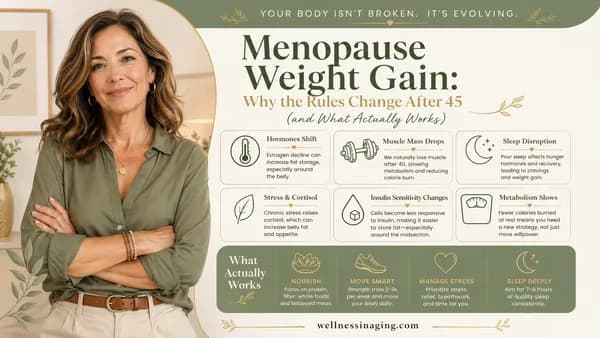
Menopause Weight Gain: Why the Rules Change After 45 (and What Actually Works)
Why menopause causes belly fat even when weight stays stable — the hormonal mechanism behind visceral fat redistribution and evidence-based strategies that work differently after 45.
Read article →